

1 Exploring Sound Qualities in Architectural Design
Space 1

The first chosen space was not a traditional room per se but inside of tramcar of line 17. The tramcar was a modern one, the Bombardier Flexity introduced in 2020.
As seen from the picture, the car was empty and the only sounds were those of the tram’s movement, announcements, and the doors opening and closing. There is a rhythm caused due to the acceleration and deceleration of the tram which majorly dominates. There is also the announcement which is pleasing to the ear. Overall, according to the “acoustics slang” I would describe the space to be warm and buzzing due to the engine noise and slightly harsh when doors open and close.
Space 2

The second space considered is a lounge in my apartment building where people gather to eat, play table tennis and watch TV. The room is box shaped, with fairly low ceilings and multiple columns.
The audio was recorded near the table tennis board, and we can hear the ball hitting the board along with multiple voices in the background from people sitting on the dinner table. I would describe the environment to be chaotic given so many overlaps of different sounds.
The second audio was recorded in the opposite end of the table tennis board. Here, the voices of people overshadow the sound from the board. We can still however, hear the faint noises of the ping pong ball.
I would describe the room to be boxy and dense: it feels like being trapped in a box, and thumpy and popy when the ping pong ball hits the board.
2 Exploring the Emotional Impact of Everyday Sounds
Space 1

The first space is the busy intersection near the Zentrum Campus where tons of students walk around along with vehicles and a few tram lines. The recording was taken around 16.30 when it wasn’t as busy as in the mornings.
The most emergent sounds are from pedestrians’ footsteps and them talking along with the noise of vehicles. Since the recording was done on the tram station, we can also hear the tram slowing down for the stop. The sound of the tram screeching to a stop and a bike motor accelerating were the catchy sounds. Idle engine sounds from cars when pedestrians are crossing were the overheard sounds.
Space 2

The second space is a walkway in Grünauring where I go for a walk/run every day. This walkway is usually calm and peaceful with very few people. There is a park next to it where kids play football when the sun is out. The recording was taken around 19:00.
Like in the previous space, the most emergent sounds are from pedestrians talking on the street. In the first audio, a kid laughing followed by the engine noises of airplanes were the catchy sounds. In the second audio, the tram can be overheard faintly on a parallel street.
Emotional Responses
In the first case, the fast-paced movement of people with many vehicles gives the sense of a busy environment. Such an environment which would be very beneficial in the mornings to get up to speed and to get rid of any morning laziness. I like to not have my earphones on in the mornings to get used to the sounds of people hustling. However, after a long day at university, I’d prefer to put on my earphones in the evening as the same sounds become a bit annoying. The high frequency screeching of trams coming to a stop was discomforting to the ear. Unnecessary honking in a busy pedestrian road would alert me.
The second case gives a sense of serenity and away from vehicles even though you can hear a few now and then. It provides a sense of calm and spending time in such spaces is a good way to unwind. In an ideal case, I would not want to hear any cars or airplanes flying and just the natural sounds of nature. People shouting or being too loud would be discomforting while shrubs and branches swaying due to high winds or animal movements will alert me.
3 Empirical and Numerical Estimation of Room Acoustic Properties
Task 1
For this task, I took my apartment lounge as the study area (space 2 from assignment 1). When doing the recording, there were about 3-5 people in the room talking.
The space has large windows on both sides along with two glass doors. The floor is a hard surface while the ceiling’s finish is perforated gypsum board. There is not much noticeable reverb in the space while listening to the clap sound and to accurately measure the reverberation, the recording was analysed using Audacity.

The results from Audacity show that to achieve a 30 dB decay it took 0.39 seconds resulting in a RT60 value of 0.78 seconds. There was no echo as no late peaks were observed.
Task 2
Reverberation time was estimated for the same space using an online RT60 calculator where the only inputs needed were the space dimensions and surface finishes.

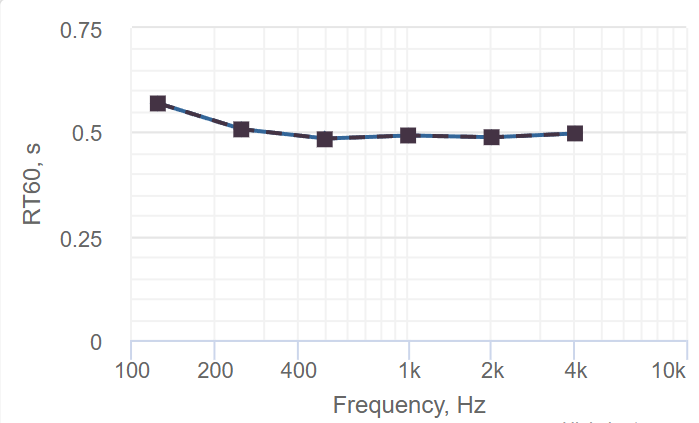
The online calculator gave RT60 values of 0.5 seconds for almost all frequencies as per Sabine equations.
4 Acoustic Design
The room given for this assignment was D24.1 in HIL. It is a typical cuboid shaped room – 13.55 m in length, 9.73 m in width and 4.83 m in height giving a total volume of approximately 640 cubic meters. The room has parallel surfaces which are highly reflecting – a floor to ceiling glass facade, concrete floor and plasterboard on the other walls. This results in high reverberation time which can be seen from the acoustic simulation results performed in Rhino using the Pachyderm package. The initial results for receiver 1 are summarized below.
| 63 | 125 | 250 | 500 | 1000 | 2000 | 4000 | 8000 | |
| T30 (sec) | 1.54 | 1.41 | 1.74 | 1.68 | 1.57 | 1.63 | 1.71 | 1.2 |
| C50 (dB) | -1.7 | -1.1 | -1.8 | -1.4 | -0.9 | -1.5 | -1.7 | 0.9 |
| C80 (dB) | 0.8 | 1.5 | 0.6 | 1.1 | 1.6 | 1.0 | 0.8 | 3.7 |
The new proposal for this room is to be changed into an open plan office to make use of the big facade for daylight and view out considerations. According to DIN18041 recommendations, the reverberation time in such rooms falls under “A2 Sprache/Vortag” category. Given the 640 cubic meters volume, this results in a maximum reverberation time of approximately 0.87 seconds.
To reduce the reverberation time, the first aim was to minimize the area of smooth surfaces. For this, a carpet was placed on the floor on top of the concrete finish which also acts as a sound absorber. Carpet Pile 6mm bonded to closed-cell foam underlay was used from the material library in Pachyderm. The absorption coefficients for the carpet and results for receiver 1 are summarized below.
| 63 | 125 | 250 | 500 | 1000 | 2000 | 4000 | 8000 | |
| % | 3 | 3 | 9 | 20 | 54 | 70 | 72 | 72 |
| 63 | 125 | 250 | 500 | 1000 | 2000 | 4000 | 8000 | |
| T30 (sec) | 1.01 | 1.06 | 1.02 | 0.99 | 0.98 | 0.96 | 0.85 | 0.66 |
| C50 (dB) | 0.65 | -0.49 | 0.52 | 1.28 | 2.65 | 3.54 | 4.38 | 6.53 |
| C80 (dB) | 3.01 | 1.79 | 2.9 | 3.73 | 5.3 | 6.17 | 7.33 | 10.11 |
As seen from the results, even though clarity improved, the reverberation time was still above the recommended values. To reduce the reverberation time further, acoustic panels were placed on the walls opposite to the facade and adjacent to it starting at a height of 2.34 m from the floor. Perforated metal(13% open, over 50mm fiberglass) was used from the material library in Pachyderm. The use of curtains on the glass facade was avoided to keep the view out. The neon colored layer in the picture below from Rhino represents the acoustic panels. The absorption coefficients for the panel and results for receiver 1 are summarized in the table below.

| 63 | 125 | 250 | 500 | 1000 | 2000 | 4000 | 8000 | |
| % | 20 | 25 | 64 | 99 | 97 | 88 | 92 | 90 |
| 63 | 125 | 250 | 500 | 1000 | 2000 | 4000 | 8000 | |
| T30 (sec) | 1.04 | 1.05 | 0.86 | 0.74 | 0.76 | 0.75 | 0.63 | 0.48 |
| C50 (dB) | -0.21 | -0.45 | 2.34 | 4.36 | 5.77 | 6.19 | 7.37 | 8.99 |
| C80 (dB) | 2.07 | 1.73 | 5.08 | 7.66 | 9.23 | 9.76 | 11.19 | 13.39 |
The reverberation time for mid frequencies (250-4000 Hz) which is critical for speech are under the recommended values. The clarity for these frequencies have also improved resulting in excellent speech intelligibility which is necessary in open plan offices. 63 Hz and 125 Hz have higher reverberation time than recommended which are not considered since they are outside the speech range. However, to improve low frequency reverberation time, Helmholtz panels can be placed to absorb these frequencies.