

1 Exploring Sound Qualities in Architectural Design
Room1: HIL F61 Studio Space
Main Purpose: Work, Discussion
For architecture students, studio spaces are the most used spaces in the school. Sometimes we work alone here on our own computers or just independently think about the projects, which means we need a relatively quiet environment. But othertimes we need to discuss with our colleagues, Assistants and Professors and many of these discussions can happen at the same time. So I think these multiple and various acoustic requirements make the studio space particularly noteworthy.
Focus on the specific example HIL F61 Studio space the situation is even more complicated. F61 belongs to a big continous open space in F Floor without division wall. The space is now shared by 3 studios with altogether around 150 students. Each single studio space is separated only through very simple wooden boards and the basic geometry is rectangular.
During working hours, many acoustic events occurred here: Like now, I can hear the voices of people discussing and laughing in another studio behind me and also on my left side, very loud. At the same time, I could hear the creaking sound of the office chairs everywhere when they are moved or turned , the sound of the door opening and closing, as well as the clicks of mouse. If I listen more attentively, I could also hear the slight sound coming from the ventilation above me.
To sum up in my own words, it’s a very noisy and loud space. In terms of “Slang” terminology, it’s hard to find an accurate word for this space. Maybe it’s kind of muddy. Because if i don’t listen very intended, all of the sounds mix together and not so clear.


According to the recording, at the first test point my voice is very clear, although the environment is noisy. At the second test point my voice is already a little bit hard to recognize. At the last farthest point my sound is totally blended in the surrounding. And in general my voice is dry with very little reverb or echo.
Room2: My Bedroom
Main Purpose: rest, sleep, work
Not like the most rooms in rectangular shape, my bedroom is in fanshape/trapezoid shape with the door on the shorter side and two windows on the longer side. That’s why I also find it noteworthy.
It’s usually very quiet. The most of the sound comes fromt the living space and outside the window. I can hear my roommate cooking in the kitchen, especially when pots and dishes clang together or when they hit the sink while being washed. I can also hear the sound of bathroom doors opening and closing. Because it’s in 1. floor, the crunching sound of people walking on the gravel path is very clear to my. In the morning there is also the sound of post cars.
Sometimes I like to have music playing in my room. And I think it’s somehow balanced. Maybe the special shape also play a role for that.


The recorder is placed on the table close to the wide side of the space and I stepped gradually back towards the door. It’s very obvious, that the sound becomes more and more reverby as the distance changed.
2 Exploring the Emotional Impact of Everyday Sounds
Situation 1: Having lunch in Fusion dining hall on the groundfloor
Fusion as a main canteen in Campus Hönggerberg is always very busy during lunchtime. I have lunch there almost every working day.
As you can imagine, It’s loud and noisy with many people talking, cutlery clinking, chairs on the floor scraping and so on. But actually you can’t clearly recognize each of the sounds or really heard what are the people talking about. All the sounds merges into a buzzy background.
Sometimes someone just laughs very loud and it catches your attention immediately. In rare cases someone drops a glass or a plate and the sudden noise is also very catchy and make you startled.
Regarding the emotions these sounds evoke, it depends on whether I’m alone there or with someone together. When I’m alone, I tend to think about some questions I meet recently or just reflects on what’s going on today’s course and review. In this situation I find these buzzy background bothers me a little bit and get sometimes even on my nerves. But when my friends and I have lunch together, we talk and laugh a lot, the sounds in the background are almost unnoticed and make me even more relax. But It’s also disturbing sometimes when the sounds become so loud that we can’t even good heard each other.


Situation 2: Sitting on the bench of Viewpoint Waid
Located on Käferberg, Viewpoint Waid overlooks the main city of Zurich and Lake Zurich. It’s a popular spot for walking and relaxing. I often take a walk there and sit for a while.
I can hear the gentle sound of water from the nearby fountain, the rustling of the wind through the trees, quiet chatting of other visitors enjoying the view, and the sound of cars passing the road below. If you listen carefully, you can even catch the faint sound of trains running through the city. all the sounds are very clear and quiet.
In terms of emotions, the sounds of water and wind — the ones coming from nature — make me feel deeply relaxed. They bring a sense of calmness and pleasure. Although sometimes a car passes by, the sound is fleeting and doesn’t really disturb the atmosphere.
What’s special about this place, is that I can even hear many light and distant sounds maybe from the lake or even more far away. Although I can’t recognize what is that exactly, these distant sounds give me a feeling of openness and lightness, which also contributes to a good mood.


3 Empirical and numerical estimation of room acoustic properties
Room1: HIL F61 Studio Space
Recorded RT60 0.576 sec

I recorded the clapping sound in this room in the evening, so there was no noise or other people as absorber.
calculated RT60 0.57 sec (at 500 Hz) 0.63sec (at 1000Hz)
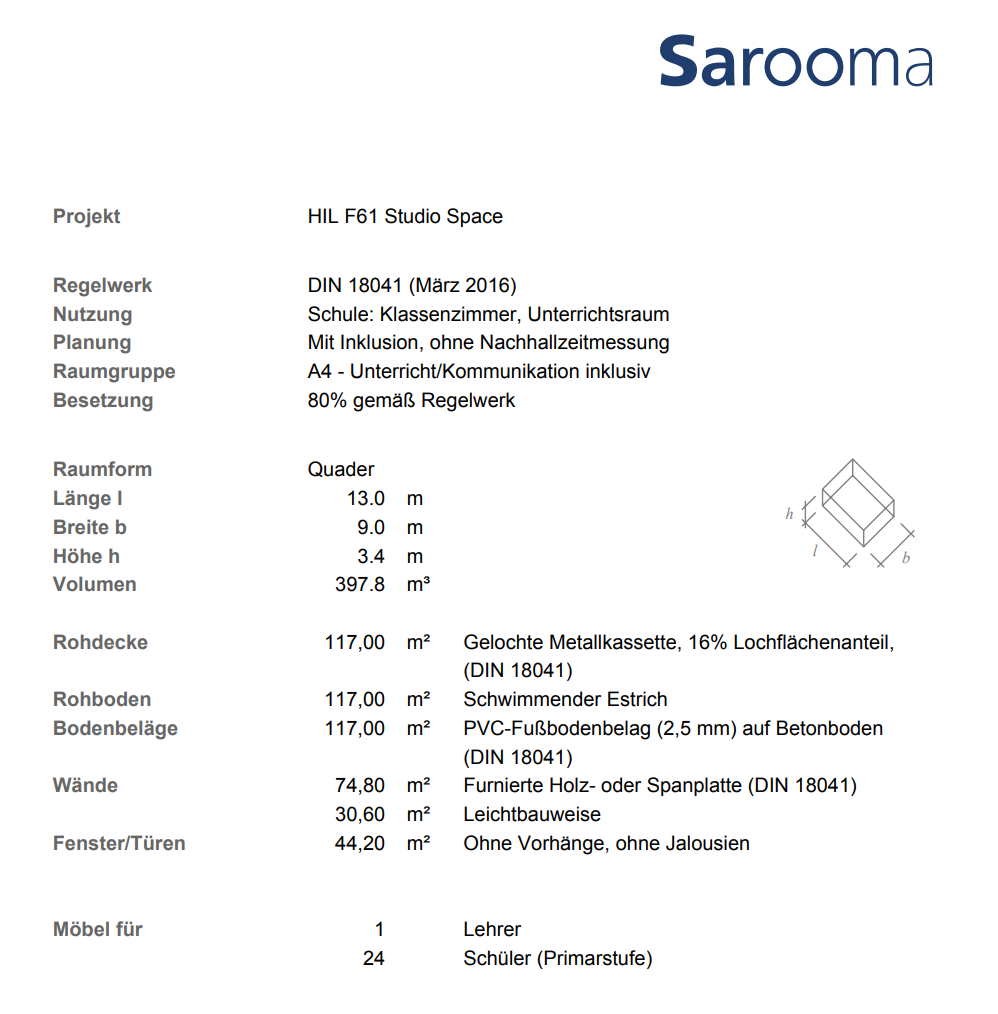

The calculated data is very similar to the recorded one. But it can be inaccurate. On the one hand, it’s because in Switzerland people use Standard SIA instead of DIN. On the other hand, All the input materials are based on my assumptions, which can be different from the reality.
Room2: My Bedroom
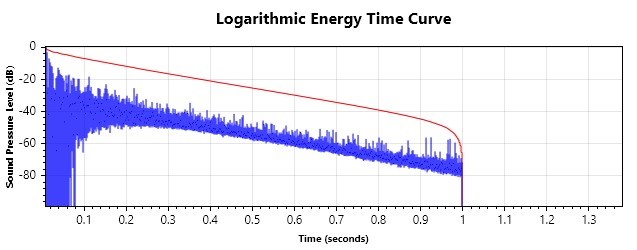
Recorded RT60 0.392 sec

calculated RT60 0.50 sec (at 500 Hz) 0.47sec (at 1000Hz)
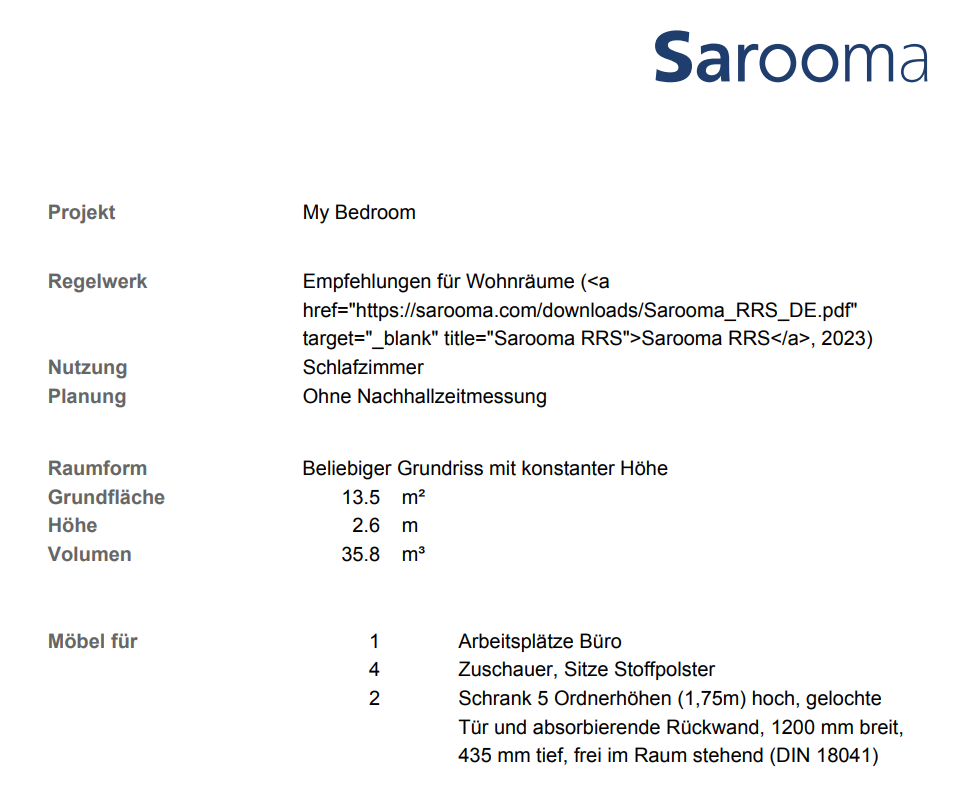

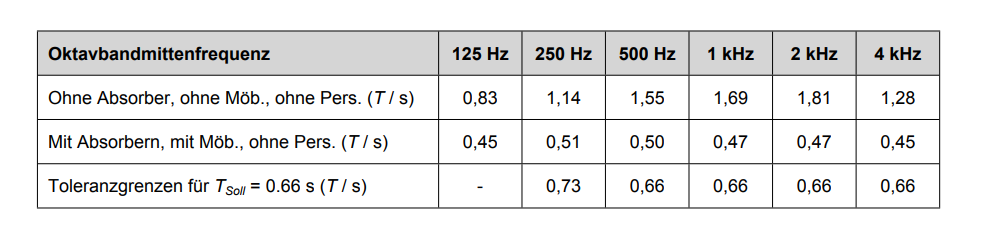
In this situation, the calculated RT60 is obviously bigger than the recorded one. That’s because, in this website there is no relevant furniture options for a bedroom. I had to choosen something else. Theoretically, huge amount of furnitures in the bedroom, such as bed, desk, chair, different cabinets, mattresses and fabrics, etc., and also clothes and private things… they all act as absorbers, significantly reducing the reverberation time.
4 Final Assignment
Intended Use: Meeting Room
Current Conditions
L= 13.55 m W=9.73 m H=4.83 m
V=636.8 m³
Reverberation Time T30/s
(T30 refers to Reverberation time obtained by linear regression over the decay curve between –5 dB and –35 dB and extrapolated to a decay of 60 dB.)
| 63 | 125 | 250 | 500 | 1000 | 2000 | 4000 | 8000 | Tₘ | |
| Receiver1 | 1.54 | 1.41 | 1.74 | 1.68 | 1.57 | 1.63 | 1.71 | 1.2 | 1.63 |
| Receiver2 | 1.53 | 1.4 | 1.71 | 1.63 | 1.52 | 1.61 | 1.7 | 1.2 | 1.58 |
| Receiver3 | 1.55 | 1.41 | 1.74 | 1.67 | 1.56 | 1.63 | 1.72 | 1.2 | 1.62 |
| Average | 1.54 | 1.41 | 1.73 | 1.66 | 1.55 | 1.62 | 1.71 | 1.2 | 1.61 |
Clarity of Speech C50/dB
| 63 | 125 | 250 | 500 | 1000 | 2000 | 4000 | 8000 | |
| Receiver1 | -1.7 | -1.1 | -1.8 | -1.4 | -0.9 | -1.5 | -1.7 | 0.9 |
| Receiver2 | -2.1 | -1.5 | -2.2 | -1.8 | -1.4 | -2.0 | 2.3 | 0.0 |
| Receiver3 | 0.3 | 0.8 | 0.1 | 0.5 | 0.9 | 0.3 | 0.1 | 2.6 |
Speech Transmission Index STI
| Receiver1 | 0.51 (Fair) |
| Receiver2 | 0.51 (Fair) |
| Receiver3 | 0.55 (Fair) |
According to the current acoustic measurements this room has a relatively long reverbration time and can sound very live and reverberant. The C50 values from receiver 1&2 are negative across almost all frequency bands, which means that late reverberation dominates over early reflections and resulting in very poor speech clarity in these directions. In terms of STI “fair” means also that in this room speech can be understood but not clearly or comfortably. So it’s very obvious, that this room now is not suitable for the use as a meeting room.
SIA Norms for the Meeting Room

According to SIA 181/1, meeting rooms belong to Type of Use 1C “Communication-intensive uses with multiple simultaneous speakers distributed throughout the room.” Generally speaking, communication involving multiple speakers in this kind of room must be possible, including for people with hearing impairments or foreign-language users. Furthermore for rooms bigger than 500 m³ is this kind of use not suitable. The volume of the room we plan is 636.8 m³, which means in order to transform it into a meeting room the first step I need to do is reducing its effective volume. One way to achieve that is to adjust the height of the suspended ceiling. The exiting ceiling is 4m high. I plan the new ceiling at the height of 3.75m. The corresponding volume is 494.4 m³.

From SIA 181/1 Raumakustik p12
According to SIA 181/1, in this room Tsoll=0.56s
Acoustic Treatment
- Absorption panels on the ceiling directly above the conference table
2. Absorption panels on the parallel walls at seated head height
3. Acoustic Curtains on the glass façade
Total Area of Absorption panels = 91.5 m²,PET Panels
Acoustic Curtains = 50.85 m²


Absorption panels are installed on the ceiling directly above the conference table, which is particularly effective because human speech naturally radiates upward at an angle of about 30 degrees. This means the ceiling receives a large portion of the initial sound energy, and treating it significantly reduces reflections and enhances speech clearity.
Parallel wall surfaces create specular reflections that bounce between the walls at short intervals. Adding absorption to these surfaces interrupts this reflection path and reduces the reverberation time.
Simulation & Calculation

Situation 1 with the curtains open
Situation 2 with the curtains closed
Reverberation Time T30/s
| 63 | 125 | 250 | 500 | 1000 | 2000 | 4000 | 8000 | Tₘ | |
| Receiver1-original | 1.54 | 1.41 | 1.74 | 1.68 | 1.57 | 1.63 | 1.71 | 1.2 | 1.63 |
| S1 | 1.25 | 1.42 | 1.32 | 0.81 | 0.88 | 0.81 | 0.66 | 0.51 | 0.85 |
| S2 | 1.28 | 1.36 | 1.1 | 0.63 | 0.66 | 0.6 | 0.55 | 0.44 | 0.65 |
| Receiver2-original | 1.53 | 1.4 | 1.71 | 1.63 | 1.52 | 1.61 | 1.7 | 1.2 | 1.58 |
| S1 | 1.26 | 1.42 | 1.34 | 0.81 | 0.83 | 0.82 | 0.69 | 0.52 | 0.82 |
| S2 | 1.3 | 1.39 | 1.11 | 0.6 | 0.61 | 0.61 | 0.49 | 0.4 | 0.61 |
| Receiver3-original | 1.55 | 1.41 | 1.74 | 1.67 | 1.56 | 1.63 | 1.72 | 1.2 | 1.62 |
| S1 | 1.27 | 1.41 | 1.33 | 0.79 | 0.83 | 0.77 | 0.66 | 0.51 | 0.81 |
| S2 | 1.28 | 1.37 | 1.13 | 0.62 | 0.59 | 0.52 | 0.5 | 0.42 | 0.61 |
Clarity of Speech C50/dB
| 63 | 125 | 250 | 500 | 1000 | 2000 | 4000 | 8000 | |
| Receiver1-original | -1.7 | -1.1 | -1.8 | -1.4 | -0.9 | -1.5 | -1.7 | 0.9 |
| S1 | 0.94 | 0.09 | 0.68 | 6.64 | 5.13 | 5.95 | 7.47 | 8.8 |
| S2 | 0.13 | -0.06 | 1.88 | 8.21 | 8.75 | 9.03 | 10.1 | 11.19 |
| Receiver2-original | -2.1 | -1.5 | -2.2 | -1.8 | -1.4 | -2.0 | 2.3 | 0.0 |
| S1 | 1.2 | 0.48 | 1.45 | 6.43 | 5.17 | 6.61 | 7.41 | 9.47 |
| S2 | 0.62 | 0.12 | 2.04 | 7.98 | 9.56 | 10.41 | 12.08 | 13.44 |
| Receiver3-original | 0.3 | 0.8 | 0.1 | 0.5 | 0.9 | 0.3 | 0.1 | 2.6 |
| S1 | -0.06 | -0.56 | 0.08 | 4.66 | 4.73 | 4.87 | 5.77 | 7.52 |
| S2 | 0.01 | -0.22 | 1.31 | 6.98 | 7.62 | 8.27 | 8.77 | 10.63 |
After the treatment, In situation 1 with curtains open, there is a obvious reduction in mid- and high-frequency reverberation times at all receiver positions. However, the values still do not fully meet SIA requirements. Low-frequency reverberation times changed only slightly, because the selected materials are designed primarily for mid- and high-frequency absorption. For a meeting room, this is acceptable since human speech mainly occupies the mid–high frequency range, making low-frequency reverberation less critical to the room’s function. The C50 shows an even more remarkable improvement, which is critical for speech intelligibility.
In situation 2 with curtains closed, both T30 and C50 are further improved. Although T30s in many frequencies are still longer than 0.56s, the most of they fall within the SIA tolerance range.

| 63 | 125 | 250 | 500 | 1000 | 2000 | 4000 | 8000 | |
| Max. | 0.95 | 0.81 | 0.67 | 0.67 | 0.67 | 0.67 | 0.67 | 0.67 |
| Tsoll | 0.56 | 0.56 | 0.56 | 0.56 | 0.56 | 0.56 | 0.56 | 0.56 |
| Min. | 0.28 | 0.36 | 0.45 | 0.45 | 0.45 | 0.45 | 0.36 | 0.28 |
Conclusion
In order to transform this room into a meeting room, huge amount of absorber is needed to ensure the proper acoustic performance. In practice, the budget should also been taken into acount to finally decide the area and material of the absorber. What’s more, sometimes because of unique requiements, like multifunctional meeting room, the problem of low frequencies can not be ignored.