

Assignment 1
Exploring Sound Qualities in Architectural Design
First room: air raid shelter

The room is approximately 7m2 big, has a Drumset and some cases in it and is used to practise. The snare is missing to prevent it from changing the acoustics. If the door is shut, the thick concrete walls act as a soundproof wall to the outside. Nevertheless, the acoustics on the inside are by far not absorbing in its nature.
The inside walls are covered with some absorbing material at the worst possible places (on the surfaces, not in the corners). The carpet on the floor helps reducing the loudness of every sound.
In the air raid shelter I’m able to hear my heart beat if no other noise is present. As soon as someone talks though, it gets really loud really fast. When I talk, the space boosts the lower frequencies of my voice. An almost uncomfortable feeling. You start to feel your whole voice on your body, as if you sat on a bench with someone talking to you with a really deep voice and you’re feeling the vibrations of the voice in your back. The lower frequencies also experience a rather long reverberation time, while the overtones get absorbed by the acoustic panels.
My voice in 20cm distance to the microphone
My voice in 1m distance to the microphone
My voice in 3m distance to the microphone
The boominess gets really audible in the 3m recording. With that a dullness lies in the voice and every other sound. The 20cm recording manages to avoid the boominess, but since the recordings were made with a phone the quality has to be seen relatively.
Shutting the door
An example that makes this resonant boominess clearly audible.
Second room: indoor swimming pool Bläsi Höngg, wardrobes

The wardrobes are a long space of around 25m2. They have an acoustic connection to the showers and all the other wardrobes (2m ceiling spacing). The wardrobes contain several lockers that are made out of iron. The ceiling are composed of corrugated iron supported by steel beams. Several big pipes run along these beams for proper ventilation, they are clearly audible as some sort of constant rushing murmuring background noise.
The floor panels consist of several mosaique-type plates and don’t contribute to the acoustics too. Because it is a public space and people usually don’t spend a long time in the wardrobe, their acoustics are not too important. But speech should be understandable through the whole swimming pool, for the safety of everyone. Maybe that’s why lifeguards have that high whistle?
First the recording gives the listener a sense of the ambient sound. It is generally really diffuse, reflective and noisy in general. Some children are screaming in the next wardrobe and the ventilation system on the ceiling makes a rather lot of noise. Sometimes a hairdryer or a shower splashing can be noticed, but really only in the background. The humming of the ventilation and its reverberation forms the big part of the soundscape.
Allthough there is no sound isolation at all, speech can be understood better than expected. From over one meter distance my voice starts to sound really dense and almost a bit muddy, but not over the top. It almost has a balanced part to it, but I wouldn’t consider it as pleasant sounding.
The typical indoor swimming pool acoustics can definitely be identified. They are characterized by small events that sound like big things and an (in this case not too excessive) echo in combination with a constant high noise level.
Assignment 2
Exploring the Emotional Impact of Everyday Sounds
First location: tram stop Schaffhauserplatz
I was at Schaffhauserplatz when traffic and pedestrian activity were moderate. The stop is surrounded by some cobblestone streets, shops, and cafés, with trams arriving every few minutes.
Soundscape observations
- Tram wheels screeching slightly as they brake
- Doors opening and closing with a mechanical hiss
- Conversations in Swiss German and other languages
- Bicycle bells, footsteps on stone, distant car engines
- Occasional sirens or delivery trucks passing by
- Wind rustling through nearby trees, mostly covered by urban sounds
- Tram arrival and departure — the screeching and mechanical hiss dominate the soundscape momentarily.
- Sirens and bicycle bells — high-pitched and urgent, cutting through ambient noise.
- Conversations and footsteps — constant and overlapping, forming a textured background.
Emotional response
The soundscape felt dynamic and slightly chaotic, but familiar. The rhythmic arrival of trams and the hum of urban life created a sense of movement and routine. The screeching of tram wheels was slightly uncomfortable but the overall environment felt safe and predictable.
- Volume: Medium to high, with occasional spikes (trams, sirens)
- Frequency: High-pitched sounds (bells, brakes) were most noticeable
- Context: The urban setting made the noise expected and tolerable
- Sirens and bells as alternating sounds
Second location: Letten-Limmatquai
I visited the Letten-Limmatquai in the early evening. The area is calm, with joggers, few cyclists, and people sitting by the water. The Limmat flows steadily, and the environment is more natural than urban.
Soundscape observations
- Flowing water — steady, soft, and rhythmic
- Wind through trees and bushes
- Birds chirping and ducks quacking occasionally
- Distant traffic from the bridge
- Bicycle wheels
- Occasional conversation or laughter from passersby
- Water flow and footsteps are consistent and are likely to be overheard
The soundscape was calming and introspective. The steady flow of the river and rustling leaves created a peaceful atmosphere. The occasional human sounds added warmth without disrupting the tranquility.
Emotional Response
Volume: Low overall, with gentle fluctuations
Frequency: Mostly low to mid-range, with occasional high-pitched bird calls
Context: Natural setting enhanced relaxation and focus
No discomforting sounds heard.
Assignment 3
My guess for the reverberation time RT60 would’ve been between 2.5 and 3 seconds, so quite a lot. Already the visuals on Audacity were unexpected for me, I really expected the drop to be longer.

I calculated 1.59 seconds for RT60. That’s lower than I expected it to be. I cannot identify any echoes in the impulse decay. You probably could, with a lot of imagination, and I think in every room it happens a little.
The reverb seems to be waaay lower than I expected. Now as I’m writing the text I fear I placed the microphone too close to the absorbing panels in the room which made the recording sound different than what I heard. Same as the effect you notice when you lie down on a sofa or something similar.
Calculating the room with sengpiel gives me around 0.7s of reverberation time. Something seems to be off haha. Could this be due to the drumset that is still in the room and probably adds a ot of reverb due to the drums that amplify the reverberation time of the clap?
Final Assignment
Unbelievable that there is no space to rehearse for an opera at ETH. That’s why I aim to transform the room D24.1 in HIL into an Opera rehearsal. For this assignment I neglect the lack of space for the stage and the orchestra.
Current conditions:
Length: 13.55 m, Width: 9.73 m, Height: 4.83 m, Volume: 636.8 m3
Floor area: 131.3 m2
Ceiling area: 131.3 m2
Glass façade: 65.4 m2
Remaining plasterboard façade: 159.4 m2
The reverberation time of the room is quite long and the room can sound quite echoey and live. However, for the designated use as a opera rehearsal room a long reverberation time is needed. Due to the negative C50 values late reverberation dominates and early reflections are not that audible. That results in a bad speech clarity, which is not good for an opera rehearsal room, where singing is a main activity. The following improvements and adjustments will make the room suitable.

Tsoll in H24.1 as an opera-rehearsal room should be around 1.3s according to Figur 1 (curve 1a is the decisive one since Nutzungsart 1a is music).
Operahouses often have a big amount of diffusors in the form of decoration. This decoration is quite accurately imitated by the installations on the ceiling. This is the first advantage of that, and the second is, that it’s cheaper to only intervene at the walls and leave the installations on the ceiling as they were.
Interventions
To reduce the reverberation time (but not too much) and avoid a “Flatterecho” i chose diffusers like these:

They absorb a little, but diffuse a lot of sound, which is helpful in a rehearsal room, that everyone hears the orchestra similar and the separate sounds mix well.

Room without reflectors/absorbers:

Room with reflectors/absorbers:

I calculated the amount of reflective Panels to 48m2 as seen above. That results in the following RTs:
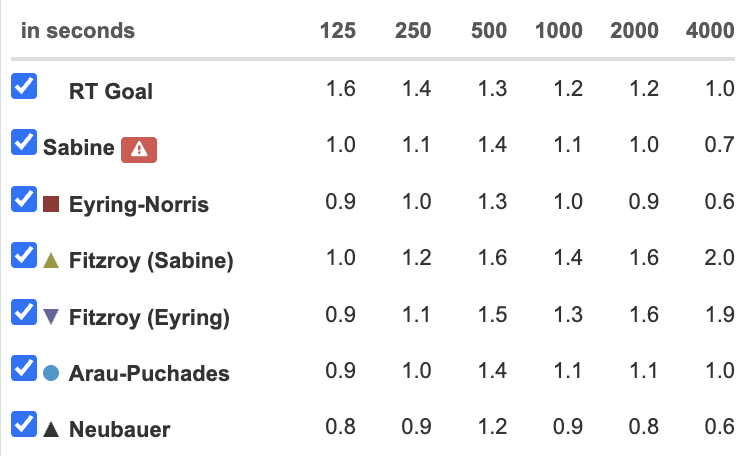

These reflectors and absorbers absorb a little bit too much low frequencies. But since the reverberation time is more or less constant over all “Terzbänder” I take this as a good thing, because in music it is important that all frequencies are weighted the same.
I also aimed for a little lower reverberation times than the 1.3s according to SIA181, since the acoustics in rehearsal rooms are most the time a little less reverberant to be able to hear out even the smallest mistakes.
Consideration of background noise: Technical systems and equipment not coveredb SIA 181 must not exceed a LH,tot level of 35 dB in rooms of usage type 1a to 1c (so also this rehearsal room). Higher levels may be tolerated when using sound systems.
No background noise levels are given for room H24.1, therefore I assumed that no measures need to be taken.