

Exploring Sound Qualities in Architectural Design
Assignment 1 | 02.10.2025
Supermarket Aldi Altstetten
Purpose and description
The Aldi Supermarket in Altstetten is a medium-sized supermarket with both groceries and household products. There are multiple shelves which create the pathways in the space. These shelves are not reaching the ceiling, so all the pathways are acoustically connected, and the supermarket can be seen as one big space.
This space seemed noteworthy in terms of acoustics because there is a combination of sounds of shopping customers, people checking out, and employees stocking the shelves. I am curious whether supermarkets are designed acoustically with a conscious approach.
Based on the pictures, it is clear that the tile floor is a reflective surface. However, the ceiling consists of a suspended ceiling, which is likely to be acoustically absorbent. Probably the shelves are not creating much reverberation.
Photos

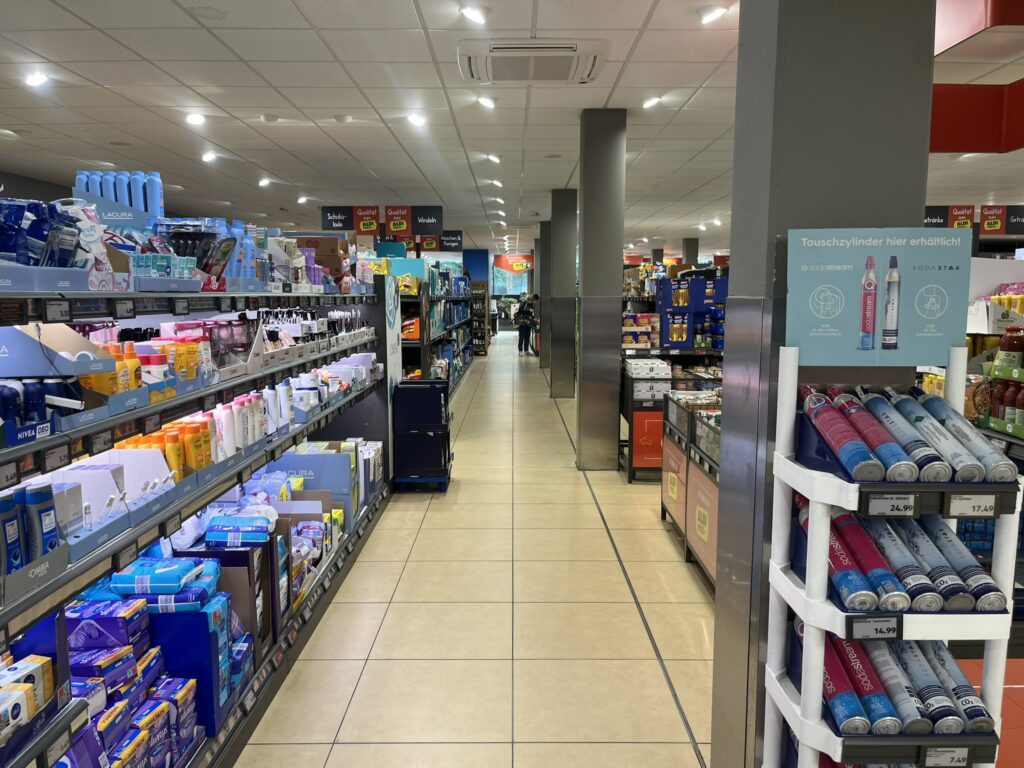


Acoustic events
The following acoustic events and sources were noticed during the site visit:
- Wheels of shopping carts moving around
- Bleeping cash registers
- Moving entrance gates
- Buzzing of het freezing department
- Crinkly packaging
- People talking (barely)
- Sliding entrance/exit doors
- Crinkly plastic fruit and vegetables bags
Recording
I recorded the same sentence at different distances from my phone’s microphone.
20 cm – In the first audio fragment, you can clearly hear my voice. Also, the beeping sounds of the cash registers are quite present. Besides, you hear some packaging crinkling and a constant buzzing background noise.
1 m – At 1 meter, you can still hear my voice, but the volume of the surrounding sounds has increased. Especially the general background buzzing is louder. Also, you hear the packaging more clearly.
1,5 m – At 1 meter, you can still hear my voice, but the volume of the surrounding sounds has increased. Especially the general background buzzing is louder. Also, you hear the packaging more clearly.
2 m – My voice is in this scenario almost drowned out by the other acoustic events. Also, the sliding doors are now clearly audible.
Adjectives
The following adjectives describes the space:
- Live: there is quite some reverberation, and you can hear that there are multiple activities going on at the same time.
- Boomy: the general buzzing sound contributes to this
- Muddy: the incidental sounds are muddled and unclear
- Open and spacious: relates to ‘live’, you can hear multiple sounds in the same space
- Noisy: because of the general buzzing sound it is generally noisy
Terrace near construction site
Purpose and description
The terrace from my apartment is on the 4th floor and looks out over a courtyard. The building block is U-shaped. A few tables and chairs are placed on the terrace. The floor is covered with tiles and a bit of gravel. The surrounding walls of the building are concrete and have a few windows, and function as reflective surfaces.
The space is noteworthy in terms of acoustics, because it is interesting to experience the effect of the surrounding activities. Especially the construction site next to the building produces a lot of acoustic events. I think it is interesting that the terrace, which is probably meant to be a calm space, is actually a very disturbed and unpleasant space. This is mainly because of the sounds of the construction site and the nearby highway. Besides, there are almost no sounds of people talking or walking audible.
Photos
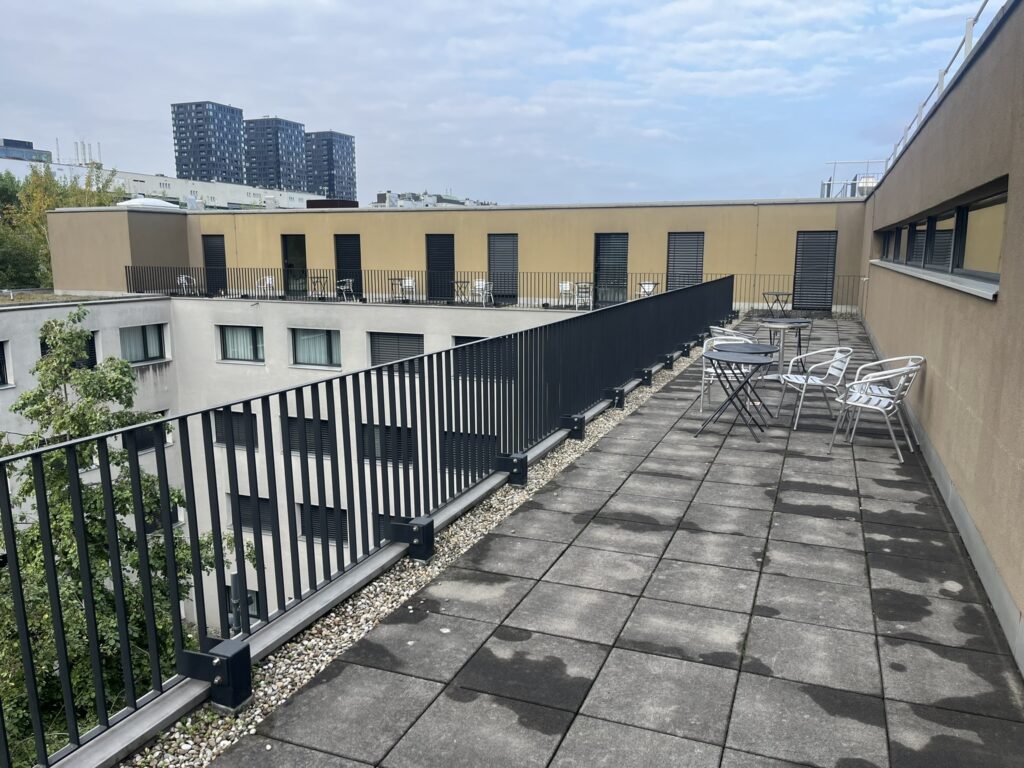


Acoustic events
The following acoustic events and sources were noticed during the site visit:
- General noise from the cars driving on the highway
- The sounds of the wheels of the cars on the street in front of the building
- Constant buzzing noise from the crane on the construction site
- Sometimes louder sounds come from the trucks moving gravel and earth
- Humming vibrations further away, which may come from planes or helicopters
- Pile driver machine going up and down
Recording
I recorded the same sentence at different distances from my phone’s microphone.
20 cm – In this fragment, you can mainly hear my voice and a general buzzing noise. The sounds from the construction site are not present.
1 m – The contrast to the previous audio fragment is clearly audible. The surrounding general buzzing is louder. Also, the more incidental sounds, such as banging sounds from the truck moving gravel and earth, are slightly audible.
1,5 m – The buzzing is even louder, and you can hear the higher-pitched sliding sound of the pile driver in the beginning. The banging of the trucks is clear.
2 m – The buzzing is even louder, and you can hear the higher-pitched sliding sound of the pile driver in the beginning. The banging of the trucks is clear.
Adjectives
The following adjectives describes the space:
- Boomy: mainly, low frequencies are audible
- Heavy: because of the loud and low construction machinery, the space feels heavy and wide
- Dull: the fact that it is an outdoor space at a higher level contributes to this lifeless atmosphere
- Muddy: human speech and sounds, such as walking, are barely audible
- Loud: the big construction machines produce loud and overwhelming noises due to their size
Exploring Sound Qualities in Architectural Design
Assignment 2 | 16.10.2025
ONA Studio Space


List of sounds
- People talking right behind me, not too loud
- Clicking mouse
- Cracking chair
- Clicking keyboard
- Mumbled voices behind glass wall
- People walking/moving
- Rolling chairs
- Capsule coffee machine
- Buzzing fan of laptop
- People coughing
- Booklets moving on the table
- Someone blows one’s nose
- Someone sneezing
- Church bell ringing outside
- Heavy door opening and closing
- Keys ringing
- Mugs moving on the table
- Birds outside (very soft)
Influence emotional state
The space has a calming effect to me. It helps me focus on studying, because all the sounds are related to studying. Als the general educational context, helps me to focus and turn myself into work mode.
I prefer it to be not completely silent, because otherwise I tend to be too aware of my own movements and sounds. In a way it feels cozy, because of the fact that you can hear other people, talk to each other in a soft way.
On the other hand, I feel slightly uncomfortable making loud sounds, because of the calm environment. Besides, the space is encourages me not to interact with people sitting at other tables.
Because the volume is in general quite low, the change can be high, which than immediately catches my attention. For instance when somebody at my table start talking, I immediately start listening carefully. The people sitting at the table behind me, I can overhear, but do not completely catch my attention. Than there are the people talking behind a glass partition wall, these mumbling sounds I filter automatically. This background mumbling is more or less constant at low frequencies. So higher frequencies, such as the chairs cracking, stand out.
Platform Oerlikon Trainstation

List of sounds
- Train announcement voice
- Squeaking train during departure, sound and frequency increase
- Train arriving, sound and frequency decrease
- Muffled sound coming from rails when train is coming
- People shouting in the distance
- Alarming beeping of closing doors
- Running footsteps on the stairs
- Plane crossing
- Someone speaking on the phone
- Tram in the distance
- People talking, barely audible
- Hissing of overhead lines
- Footsteps of people on the platform, only audible when it is very quiet
- Locomotive making buzzing noise
- People laughing, only high frequencies
- Conductor’s whistle
- Heels on the platform
- Constant buzz of train cooling
Influence emotional state
In general, I feel small on the platform because of the loud and heavy sounds of the arriving and departing trains. These low frequency sounds are definetely the most emergent. All soft “human” sounds are drowned out by large machines. When I listen carefully, I get the feeling that “I don’t want to be here, but I have to be here”. There are almost no voices audible, so it doesn’t feel interactive or cosy in any way.
The alarming beeps of the train doors makes me nervous. Moreover, it is very intense when the voice of the train announcement coincides with the loud sound of a train departing or arriving.
What’s more, I found it remarkable that when you stand there for 15 minutes, you hear the same sounds over and over again. This makes you lose track of time.
In general, I think that the context it influencing my perception. This is beausse for me, a train platfrom has always been a place for transfering and not staying. Now when I listened carefully I experienced more discomfort than I ever did before. Most of the time when I am at a train station I wear headphones, so maybe that also results in the fact that I never really experienced the loud volume and low overhelming frequencies of the trains coming and going.
Empirical and numerical estimation of room acoustic properties
Assignment 3 | 06.11.2025
ONA Studio Space
Recording with Audacity
For this recording test, I used the Studio space at the ONA building in Oerlikon again. I clapped and recorded 5 times. After importing the recordings into Audacity, and searched for the most clear impulses. After that, I calculated the reverberation time for – 20 dB, which is 0,215 s. When multiplying this by 3 we end up with a RT60 of 0,645 s.
No clear echoes are visible in the impulse decay.

Estimation with Sarooma
Secondly, I used the website from Sarooma to estimate the reverberation time fo the ONA Studio space. I inserted the following data. (https://sarooma.com/en/webapp/)

In the first place I couldn’t find a way to include the ceiling panels. But in the end I added it with the folliwing preset ceiling absorber on their website. By adding 125 pieces, 0.8 x 0.8 x 125 = 80 m2 of the ceiling is covered, which is 2/3 of the ceiling. This more or less aligns with the real situation in the studio space.

The following reverberation times are calculated with the related graphs below.
with absorbing ceiling:
- 500 Hz = 0.65 s
- 1000 Hz = 0.65 s
without absorbing ceiling:
- 500 Hz = 2.30
- 1000 Hz = 2.12


Without ceiling absorbers With ceiling absorbers
Comparison measurements versus online tool
As we can see are the reverberation time measured with Audacty and with the online tool the same.
Redesign room in HIL building as diverse study space
Final assignment | 04.12.2025
Intended use
Diverse study space
The use case is described as a diverse study place. It is mainly suitable for group work, but there are also desks for individual work. Besides, there are lounge areas with sofas, to take a break alone or together.
Approach: In the first place the room will be divided in zones with different study characteristics, such as individual focus, groupwork, and break-outs. Dividing the room will contribute to the acoustic qualities.
Surfaces: The floor can’t be made from soft materials, because this will be too vulnerable for food and drinks stains. The walls can not be too vulnerable, but because the room is used as a calm study place, it does not have to be extremely damage proof. At last, the ceiling is a freely treatable surface.
Requirements SIA 181/1
SIA 181/1 gives the following requirements for a room which is meant for education and communication. This aligns with the use case.

The volume of the room is calculated as: V = 13,56 * 9,73 * 4,83 = 637,26 m3
Recommended reverb time according to SIA 181/1 with this volume is:
RT = 0,26 log(637,26) – 0,14 = 0,59 sec
Relevance of frequencies
With the intended use case in mind, the main form of sounds and noise will be related to speech. The room is meant for group work, so it will not be silent. For the reverberation time, the focus is mainly on reducing it for the mid frequencies, because they will be the most relevant in the room.
- Low (125-250 Hz) Deep sounds such as footsteps
- Mid ( 500-1000 Hz) Speech sounds
- High (2000-4000 Hz) Sharp noises
Current acoustic conditions
The measurements provided show that the current reverberation time in the room is is at each frequency much higher than stated in the SIA requirements:
Measurements
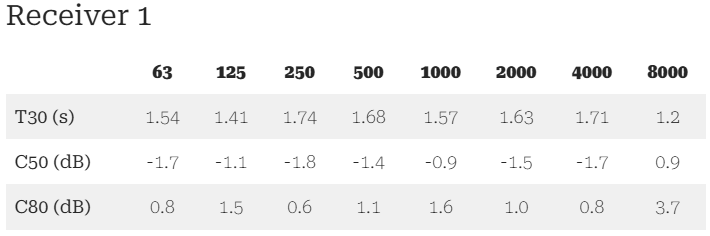

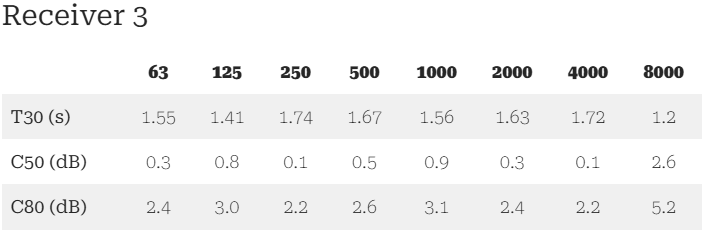
Interventions
What is needed?
When looking at the measurements, it is clear that all the frequencies need interventions to reach a RT of 0,59 sec. As said earlier the focus will be on the mid frequencies.
In the first place the following interventions have been made:
- Adding Acusorb® Vita Biophilic panels onto two walls
- Adding Mogu Kite acoustic panels onto one wall
- Adding Mogu Kite acoustic panels to seperate the room (non-slanting)
- New placement of furniture
Materials and absorption coefficients
The materials in the list above have the following absorption coefficients.
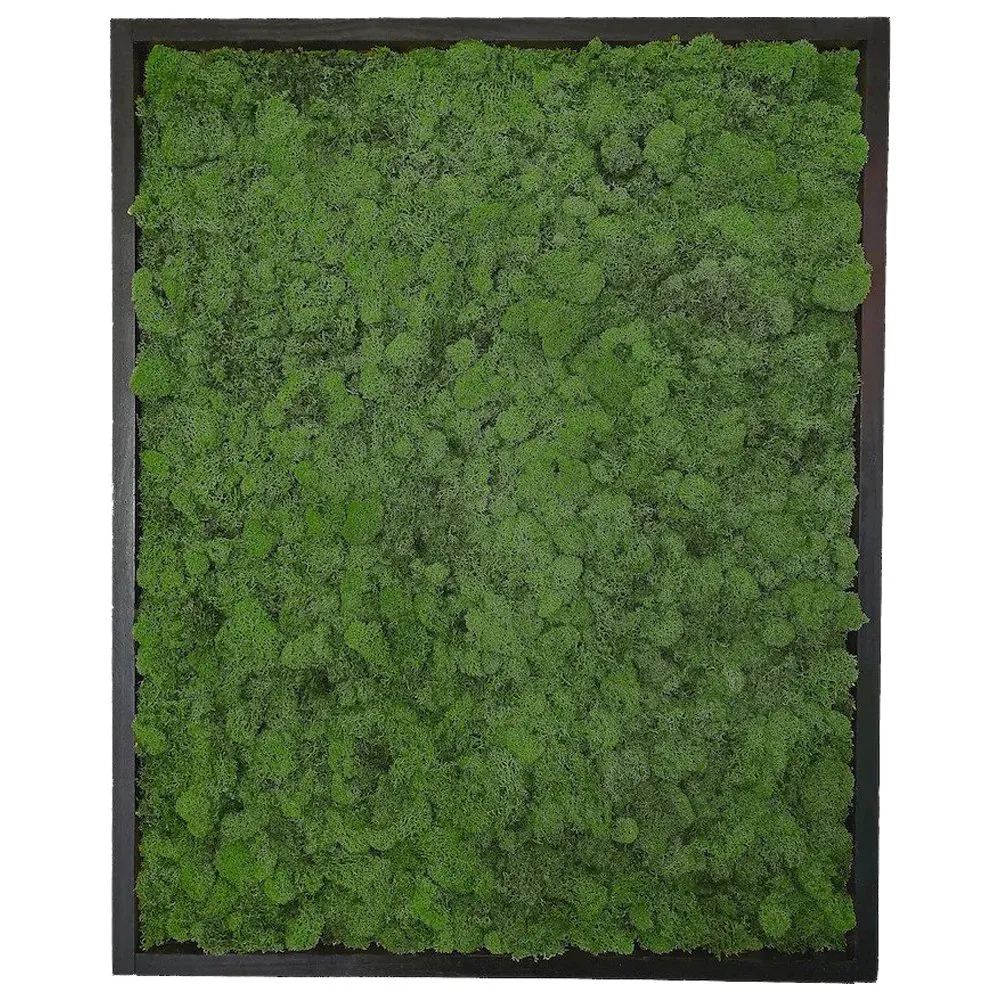
Biophilic wall panels Acusorb® Vita
Acusorb® Vita panels do not require maintenance and can be used as natural sound absorbers. Suitable for busy interiors, such as offices, schools, atria, breakout areas and retail environments.


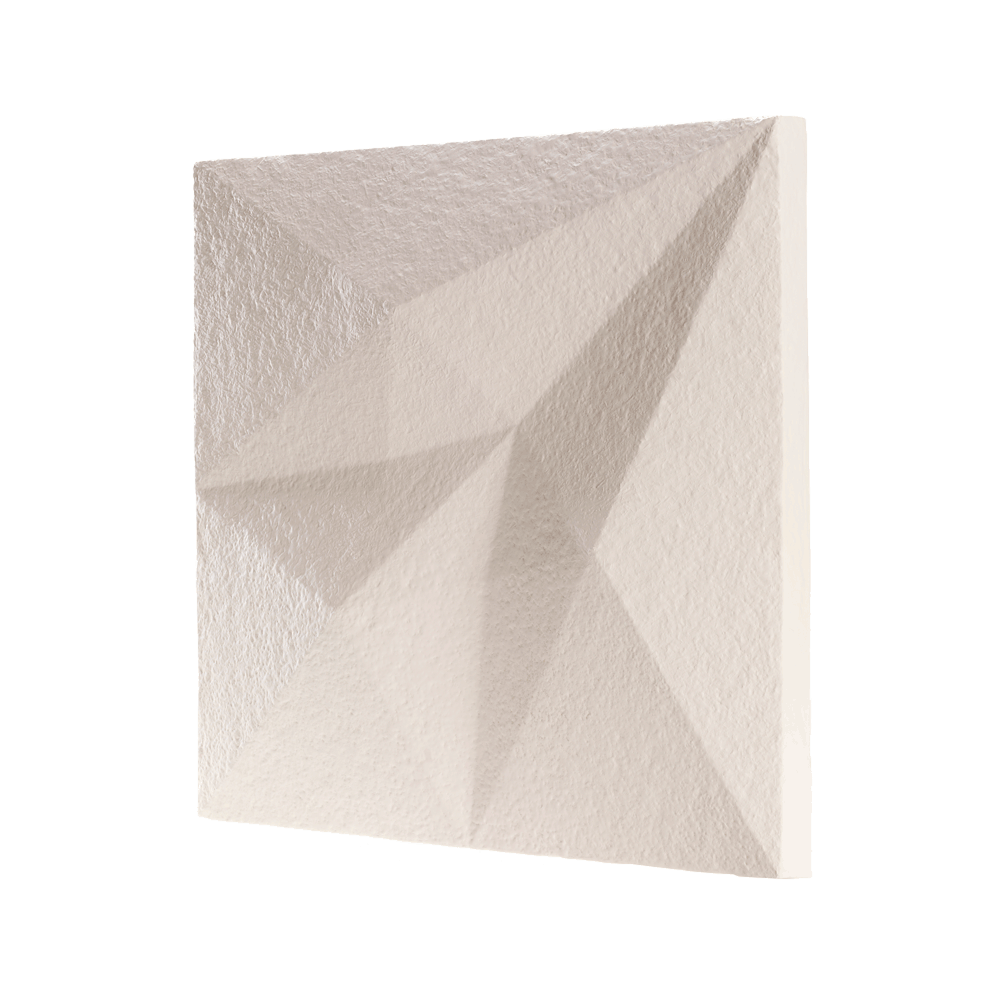
Mogu Kite acoustic panels
Mogu Acoustic Panels are 100% circular products. The panels are made from soft, foam-like mycelium materials and of upcycled textile residues. They are especially suiting for noisy spaces with a high reverberation time.suitable
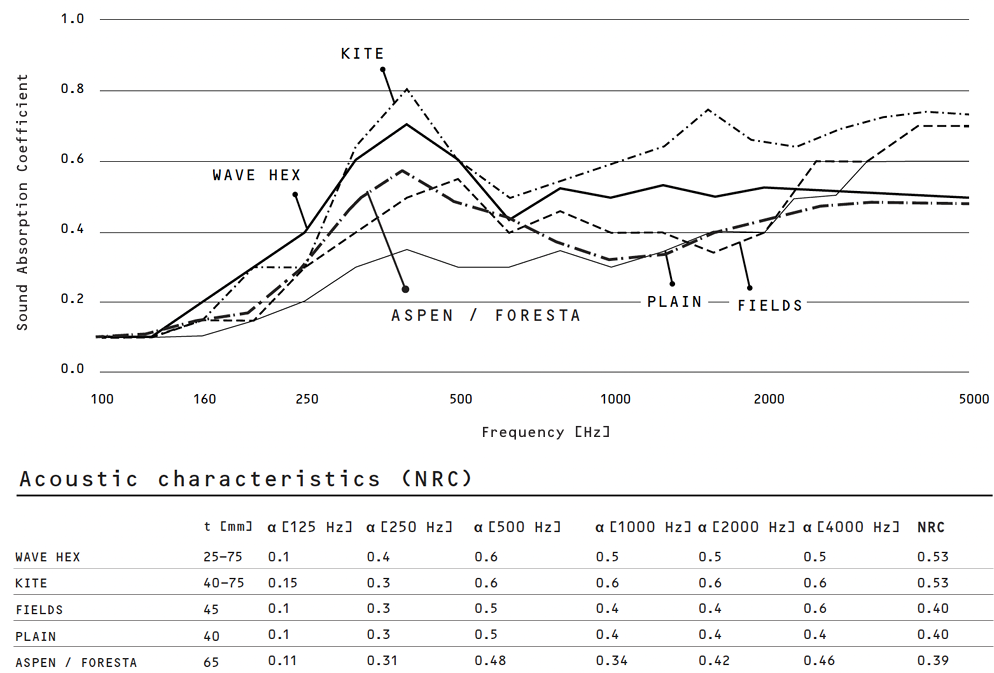
As said before, the room will be split with wall elements. These panels will be slanted with 2 degrees, to reflect the sound reflections towards the absorbing ceiling.
First Pachyderm measurement
After adding these interventions to the design, the following measurements are meade with Pachyderm (500 rays).
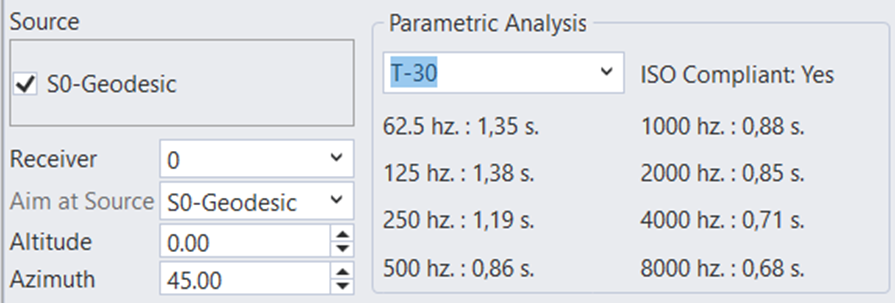
Based on this it is clear that the frequencies which need the most absorption are around 250 Hz, but also the higher frequencies in general (500-2000 Hz). To improve this Helmholtz ceiling panels are introduced.
Helmholtz ceiling panels
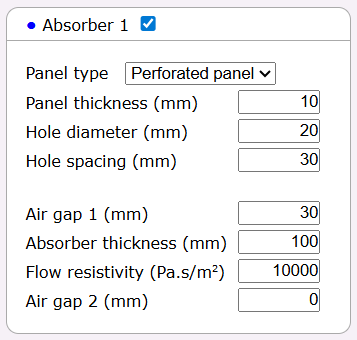
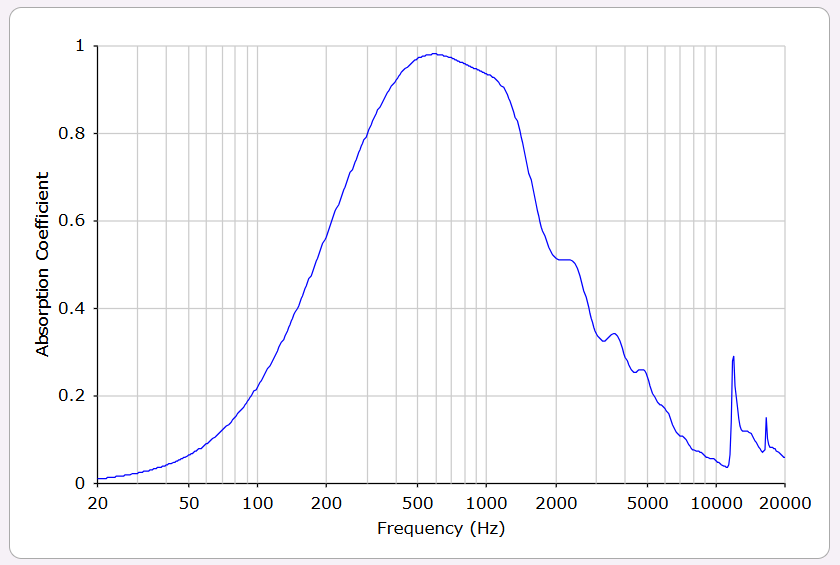
After itterating the dimensions of the Helmholtz panels, the following dimensions are set. With these dimensions, it absorbs mainly at the mid frequencies, but also some at the higher frequencies. This fits the needs of the room.

Design impression
As shown on the 3D and floor plans, the room is divided into zones by using seperating wall elements. In the first place, these were just vertical.


Slanted seperating walls
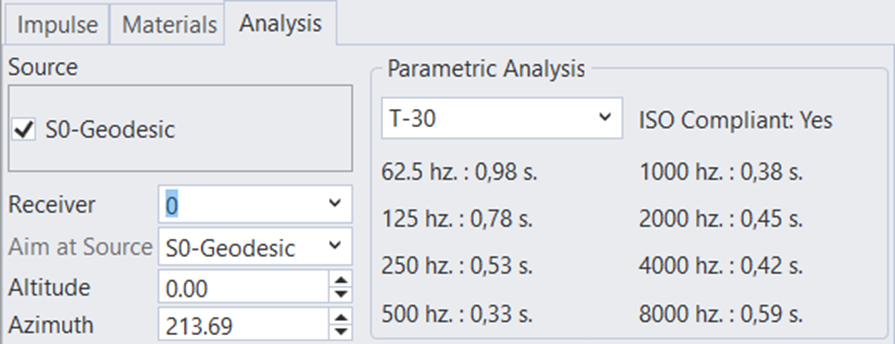
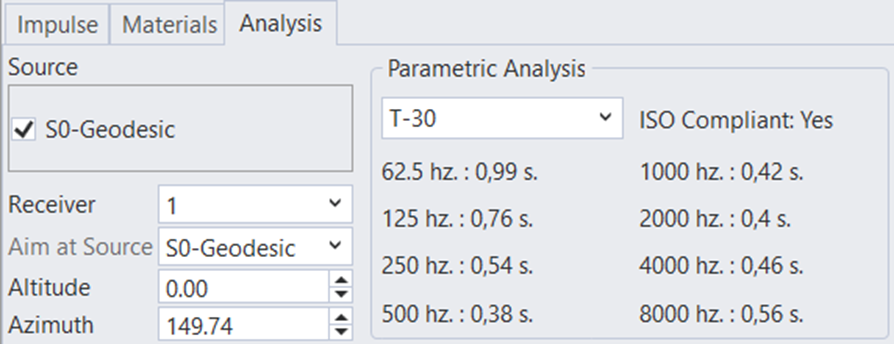
After the first measurement, the wall elements are changed by slanting them slightly. In this way the sound rays will be reflected towards the absorbing ceiling.
It can be questioned whether this has a strong effect, because the wall elements are already covered with the Mogu acoustic panels. So measurement with and without slanting were made. These showed that slanting the panels contribute to a lower reverberation time, but not significantly. Without slanting the SIA requirements are still met. The results with straight walls are shown below.
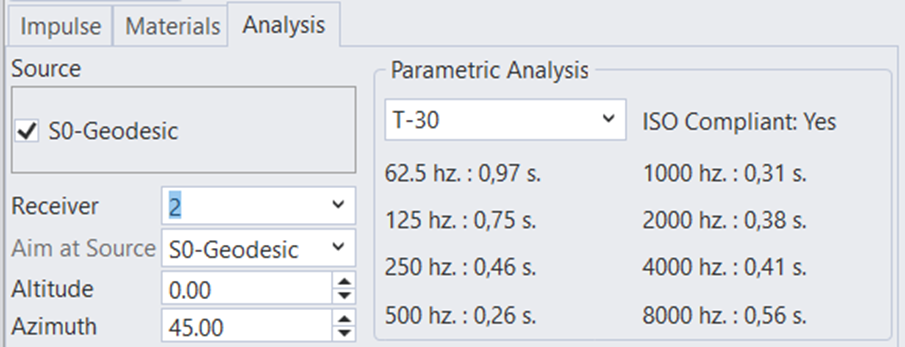
New acoustic conditions
Measurements Pachyderm
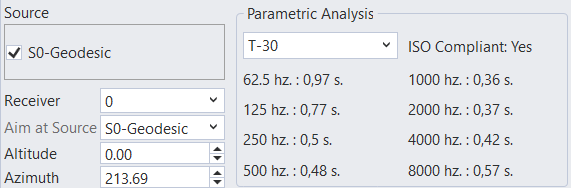
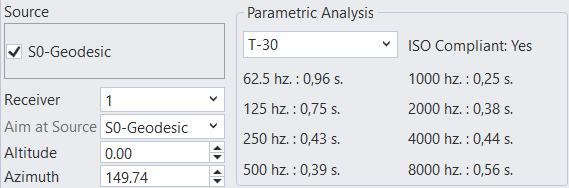
With the design above a new Pachyderm calculation has been made. (In this case the seperating walls are slanted). This led to the following results.

Conclusion
In conclusion, the Pachyderm calculation of the new design meet the SIA 181/1 (0,59 sec) requirements.