

Exercise 3
I recorded the Reverberation-Time in my Bedroom where 3/4 of the space are occupied by studio equipment and instruments.
Task 1:


Task 2:


4. Final Assignment
The Room HIL 24.1, which is currently being used as a meeting and work space is a very raw room. There is not much acoustical absorbtion and it does not offer a lot of optimisation for its current use. The Room dimensions are 13.5 x 9.73 x 4.83. The Room would be great as a recording room/studio space because it offers a lot of room for acoustic treatment in depth and length and especially in height which is a perc not many rooms have.


The ceiling is suspended and there are a lot of cables and ventilation pipes scattering the reflections on the ceiling. This is interesting for a workspace but definitely not beneficial in a studio environment therefore I would install a solid ceiling. The floor is currently out of smooth concrete and one of the walls is completely made out of glass. All in all the room does not offer a good starting point for a professional studio, but it has a lot of room to work with.
When we look at the measurements we see that all receiver positions show very similar T30 values between 1.5 and 1.7s over most frequency bands. In addition the STI value only rate as fair being in the range of 0.51-0.55. Comparing with the SIA 181/1 Norm we can see that the current reverberation time would not suffice the use of the space as a music studio.

The proposed new use for HIL D24.1 is a two-room professional music studio: one live room for recording and one control room for critical listening and mixing. This fits into SIA 181/1 as a room type where there is a clearly defined source and receiver position and where high intelligibility and sound quality are required (similar to category 1 uses for music and speech). For the existing volume of roughly 630 m³, the SIA 181/1 curves suggest a recommended mid-frequency reverberation time on the order of 0.7 s. The measured T30 of 1.5–1.7 s is therefore roughly twice as long as desired and clearly outside the normative range.

The SIA-Norm however does only describe the minimum conditions for a performeance Space and not for an actual recording studio. In this environment the target is to archieve about 0.3-0.4s T30 in the control room and 0.4-0.5s in the live room.

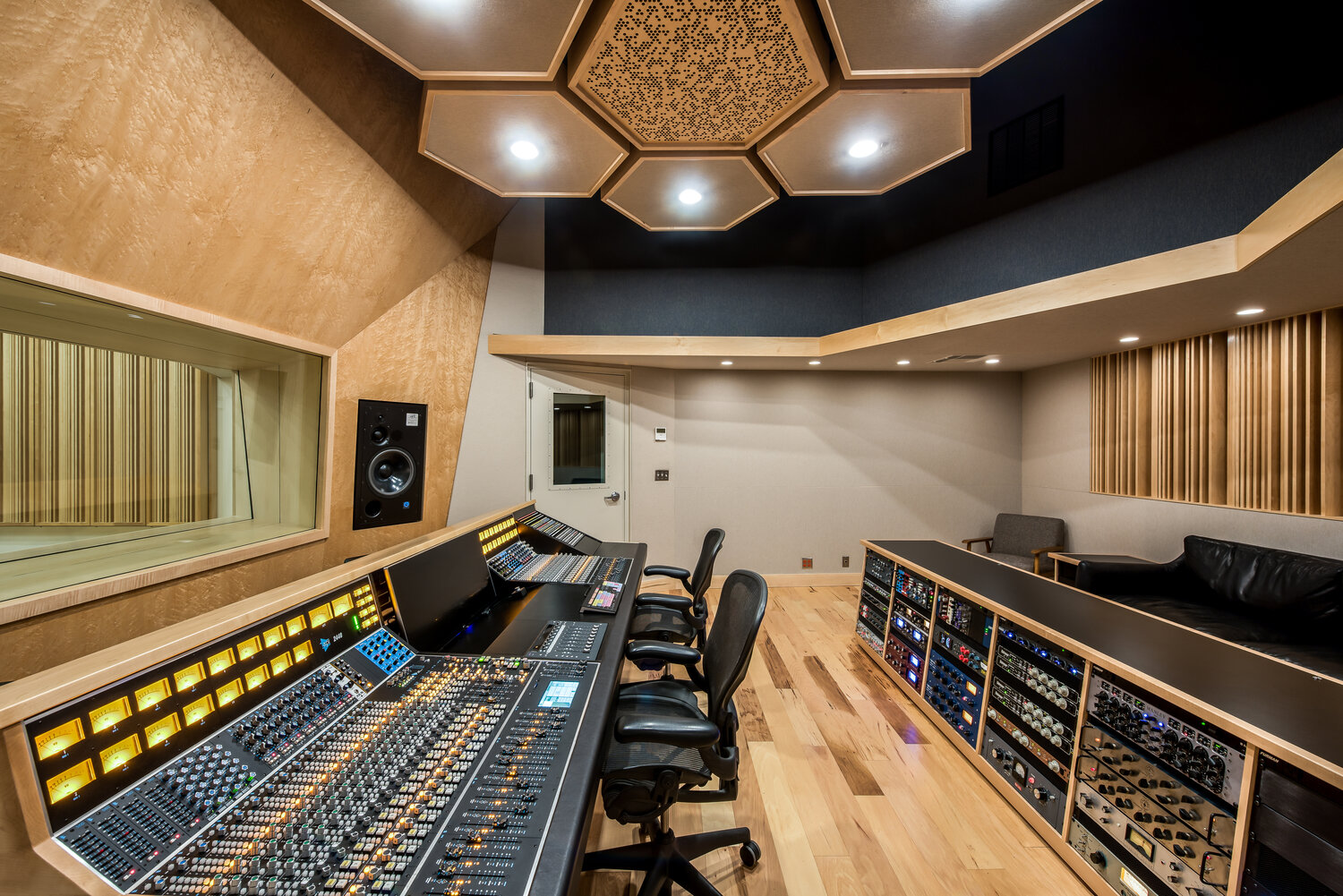

My proposition is to convert the HIL D24.1 into a professional music-studio devided into a control room and a live room for recording. According to SIA 181/1, rooms for music and speech with a clearly defined source–receiver relation and high intelligibility requirements should have much lower reverberation times than the current 1.5–1.7 s. For the reduced volumes of the two new rooms (around 180–220 m³ each), the SIA 181/1 curves suggest mid-frequency T30 values on the order of 0.4–0.5 s. In practice, a studio often aims even lower, around 0.3–0.4 s in the control room.
Acoustic treatment and construction:
The existing large room is divided into two spaces using a new double-leaf partition wall with an air gap: two independent stud walls with a cavity between them, filled with mineral wool. This “room-in-room” approach improves sound insulation between control room and live room and also helps avoid strong structural coupling and resonances. All new studio walls are built as layered constructions: heavy outer layers (e.g. plasterboard on both sides) for isolation, an air gap, and a porous, absorbing inner layer.
The suspended ceiling is replaced by a solid ceiling with a deep plenum above, filled with mineral wool. In the control room, an additional acoustic ceiling “cloud” is installed above the listening position. This creates a thick broadband absorber that controls mid and high frequencies and supports a reflection-free zone. The concrete floor is covered with a floating wooden floor and rugs, which reduces high-frequency reflections.
Low-frequency control is achieved by combining deep porous absorbers in the corners with tuned Helmholtz resonators. These resonators are integrated into the thick wall and tuned to problematic modal frequencies in the 63–125 Hz range. In the live room, wideband absorbers and diffusers are distributed over the walls, while the glass wall is covered by several layers of heavy curtains. With the curtains open, the room is livelier; with them closed, it becomes significantly drier for close-mic recording.
The plan is to part the Room into two rooms of size 4×5.5×2.75m and 4×6.5×2.75m

In both rooms a strong flutter echo around 2 kHz occurs between parallel hard surfaces. This is treated with 5 cm broadband absorbers (mineral wool) mounted on one of the opposing walls with a 5 cm air gap, covering the main reflection paths so that high-frequency specular reflections are absorbed instead of bouncing back and forth. At low frequencies, the main axial modes are at about 26 Hz, 43 Hz and 62 Hz in the recording room (4 × 6.5 × 2.75 m) and about 31 Hz, 43 Hz and 62 Hz in the control room (4 × 5.5 × 2.75 m). These standing waves are controlled by a combination of deep porous corner traps (20–30 cm mineral wool in all vertical corners and along wall–ceiling junctions) for the 60–200 Hz range and tuned Helmholtz resonators integrated into the rear wall and soffits, whose cavity volume and slot dimensions are designed to target the problematic axial modes around 25–35 Hz and 40–50 Hz. Together, this treatment removes the flutter echo, shortens the low-frequency decay and produces a much more even bass response at the listening and recording positions.
For the redesigned control room, these calculations yield T30 values of roughly 0.3–0.4 s between 500 and 2000 Hz, and about 0.4–0.5 s in the live room, with slightly longer decay at very low frequencies due to modal behaviour. This clearly improves on the existing 1.5–1.7 s, fits within the SIA 181/1 recommendations for the new room volumes and provides acoustic conditions suitable for a professional recording studio.