
1 Exploring Sound Qualities in Architectural Design
Room Nr. 1 – Hörsaal – HIL F Floor
Main Purpose: Auditorium for about 30 people, acoustics not in main focus


The room, on first glance doesn’t look acoustically interesting. It’s a great filler for space that doesn’t get natural sunlight in a wide building such as the HIL. Its boxy shape doesn’t align with the stereotypical image of the lecture hall that would come up naturally. So I was curious to see what would happen when usage remains the same, but the room changes into its very basic shape of a box.
- Audio
In this scenario we hear two people talking in normal volume. In the background we can also hear some kind of ventilation system going on, a sound even though quite loud, but due to its monotony, soon forgotten. They’re taking model photos, so you sometimes hear the camera or them shifting the models around.
- Audio
Just from the top of my mind I’d say, the room has a certain tension to it. I feel like I’m entering a rather warm, slightly dense matter. That’s how I experience the room acoustically. Probably resulting out of a combination of the acoustic properties and the muffled noises of the ventilation system.
- Audio
The room feels quite dead, noticeable because it’s otherwise quite large and empty. Boomy could also be applied here, since the lowered voices form time to time where just as audible. Listening to the people talk, vocals such as “ä” or “ü”‘s appeared quite prominently- a resonant room. It also seems quite dull – probably a result of the sound absorbing panels installed on the ceiling.
Onomatopoeia – if there’s a phenomena that leads you from sound to meaning does this also exist the other way around? Going through the list, the word boxy also seemed to resonate. But this may just be, because the rooms itself would be described the same way.
Room Nr. 2 – Girls Bathroom CAbin – HIl F Floor
Main Purpose: singular bathroom stall


This is probably one of the smallest rooms in the HIL building that one can enter as a student, but the acoustics are far more prominent than in many other rooms. That’s why it came to mind quite instantly, thinking about acoustically interesting locations.
Seeming like a quiet hideaway in contrast to the roomy atelier spaces, one almost gets startled when the door closes. The echo halls and it seems the door closing is even louder than in regular rooms.
- Audio
Live – is a very fitting description of the space. In the audio, even though I paid attention to pausing in-between the words, it feels like it’s a continuous sentence. The sound lingers and the reverb goes on for quite a long time. It feels dense – like you can almost feel the sound waves coming back to you. Especially higher frequencies such as “I”‘s appear rather prominent – sizzly.
2 Exploring the Emotional Impact of everyday sound
Mornings in the flat
Living in a shared flat can differ from day to day. Sometimes you have the hole apartment to yourself, on other days it can be quite crowded. Just like its residents changing on daily basis, so does the soundscape of the flat. Only in the mornings, the routines remain mostly the same and sound like this:
The common area is made up out of the kitchen and an adjacent dinning area, around 14 square meters. In the morning you exchange the occasional small talk, but everyone is still too tired to have a proper conversation. The background noises can be observed pretty well.
For cooking porridge or eggs, the fan is usually on. It’s a quiet loud but monotonous noise made out of bigger waves of a low bass and smaller, circulating sounds that remind of water trickling down a small river. The monotony makes it less disturbing but you still feel relieved once turned off.
In a similar volume but much darker sound color the automated coffee machine makes its appearance. Interestingly this device is highly distractive or even alerting, even though associated with the nice cup of coffee it provides. The majority of the coffee machine sound is low, dark sound which could probably merge into the background noise together with the ventilation fan. But there’s a screeching, jarring element that is hard to distinctively make out but nonetheless hard to ignore. Thankfully, making a cup of coffee only takes around 15 seconds.
More comforting sounds come from the cutlery, tinkling when someone is eating. Same thing with the wooden chairs at the dining table. Even the slightest movement produces a creaking noise, reminding of old wooden chairs you find in the living rooms of grandparents or in old cozy restaurants or mountain huts. The clock hanging on the wall, which otherwise is clearly audible, has to wait its turn to be heard until everything settles down again.
Walk in fall landscapes
Being outside has a very calming effect on most of us. The absence of noise probably contributes more to the comfort than any existing one could. But there’s a familiarity to hearing birds and wind blowing through trees, which instantly signifies that you’re outside. This also remains approximately the same, no matter where you go outside, which, for me, adds to the provided comfort. In fall, we not only hear the leaves in the trees but also the ones already on the ground. Dry and scraping across the ground, they have a quite distinctive sound. Whilst leaves in the air swish, dried and on the ground they rustle – only heard like this in the fall, which is why they draw more attention to themselves than the ones still on a tree. Crows where quite present as well, it almost seemed like they only make a brief appearance in the fall weeks and than get stored away in a decorations box until next year. Again a very distinctive sound, clearly relating to a certain memory or image I had in mind.

Almost always, cars and or planes are almost always audible in the background. Most of the time they fade out in the background. Walking past a highway showed me, how present such a noise could be. Making regular streets seem like a pleasant background ambiance.
3 Empirical and Numerical Analysis
Going back to my initial rooms, I collected data in an empty classroom or auditorium and a small, singular bathroom stall. Although I usually feel like the bathroom is a much noisier place to be, the reverberation in the class room was much more pronounced. That’s also why I chose it for my further analysis.
Task 1 – Empirical estimation with Audacity
The sound develops quite linear, with a 15 dB difference the most dense areas where around 6,5 and 6,7 . Multiplying the 0.2 seconds by 3 we end up with a RT60 of 0.6 seconds. Which comes equal to other common values for class rooms.


Task 2 – Numerical estimation of the class room
Following the formula on Sengpiel’s website I calculated the RT60 for the class room.


But first we have to take into account the absorbing surface area of the room. For that Sengpiel has an additional list of reference values. Like the following image with absorption coefficients for floor materials.
| Surface | Area | Absorption c. 500 Hz / 1000 Hz | e. a. Area |
| Walls | 108 sqm | 0.8 / 0.9 | 86.4 / 97.2 sqm |
| Ceiling | 80 sqm | 0.72 / 0.92 | 57.6 / 73.6 sqm |
| Floor | 80 sqm | 0.57 / 0.69 | 45.6 / 55.2 sqm |
| Equivalent | absorption | area | 189.6 / 226 sqm |
With the equivalent absorption area and the Sabine-formula we get a RT60 of 0.203 seconds at 500 Hz and a RT60 of 0.171 seconds at 1000 Hz.
4 Final Assignment
The spacious room located right at the entry hall of the HIL building would be the perfect location for future architectura apéros. The sometimes even weekly occurring gatherings include music and drinks and are an important part of student social life. Therefore the room should be able to host a bunch of students and acoustically support the exchange and the background music. And because there’s no apéro without drinks, the design should accommodate the gastronomic use of the space.


The most important design tasks being
- many people talking in different directions
- easy to clean surfaces throughout the room – including acoustic interventions
Acoustic conditions and treatments
Current acoustic conditions & Reverberation time

For now, the estimated room dimensions are 9.7 x 13.5 x 4.8 meters, resulting in a volume of 629 m3. The total surface area is equivalent to 485 m2. The eastern wall is fully made out of glass, whilst the others are plasterboard. Smooth concrete makes up the floor, the ceiling is suspended.

SIA Norm check
Rooms for individual communication – DIN 18041 – Nachhallzeit
Results:
The desired reverb time being 1.02 s and the absorption surfaces should come up to about 100.5 m2 .

With the intended use of the room now defined, we can get an understanding of the desired reverberation time. In this case going with “Mehrzwecknutzung”. But this only serves as a rough estimation.
As a next step, we need to evaluate the volume of the room. The needed measurements are provided by the 3D model – or for now, will be estimated. With the “Raumvolumen” at hand, we can determine the optimal reverberation time in seconds. So later, we can compare actual RV with the desired RV and we can suggest changes and additions accordingly.
Calculating the appropriate reverberation time
Even though the room would clearly benefit from a comprehensive acoustic upgrade, the question remains how frequently it will actually be used. Since this is expected to be no more than once or twice a week, a major financial investment would not be reasonable. Therefore 2c, “Räume mit mittleren Ansprüchen” is the most suitable comparison.
With a h = 4.8 m the resulting max. reverberation time is 1.02 seconds.


Calculating the equivalent absorption area
With the reverberation time and volume determined, we can transform the equation to solve for A, the equivalent absorption area, which equals 100% absorption.
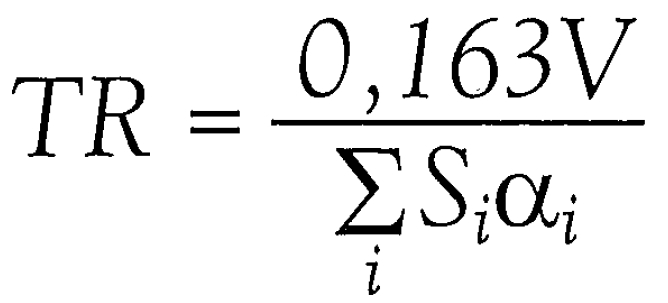
T = 1.02 s, V = 629 m3 -> A = 100.5 m2
With the Sabine formula we get an desired equivalent absorption area of 100,45 m2. We can now compare existing with needed absorption area and assign the different materials to their equivalent area in the room. From there you can determine which materials could be added or increased.

With the absorption coefficients of the materials given, we can calculate the current equivalent absorption area, which is around 80 m2 per frequency band. Taking the visitors into account, going with an occupancy of 2/3 of the room, for 500 Hz we already reach the desired absorption area.

The more people there are in the room, the lass additional acoustic treatment we need. In this case we’re looking for additional 20 m2 equivalent absorption area in the range from 1000 to 4000 Hz.


Installing porous absorbers at ear level, all around the room, would solve this problem. But in this case, the acoustic treatment could also benefit the rooms atmosphere. Douglas Textiles produces shear textiles which also act as an absorber. They can be brought in as curtains, along the glass wall or as subtle room dividers. Installed at the ceiling, extend.- and retractable, they can be brought down when there’s still less people present and rolled up, when room’s filling up.

With an absorption coefficient up from 0.6 to 0.8, we need around 25 to 33 m2 of fabric. Making the strips one meter wide, we have to install about 5 to 6 panels of the sound absorbing textile, along the walls or in the room center.
If we added an even further amount of strips, we could optimize the room qualities even for everyday situations.
The envisioned design could look something like this. The panels divide the room into more intimate spaces when there’s less people around and are also washable, which makes them suitable for an “apéro space”. The panels alongside the walls can stay down even when the room gets more crowded and act as the additional absorber to meet the acoustic requirements.