Assignment 1 – Exploring Sound Qualities in Architectural Design
In this assignment, I studied the profile of two rooms using appropriate terminology to describe their acoustic features.
1. Alumni Lounge, ETHZ Hönggeberg
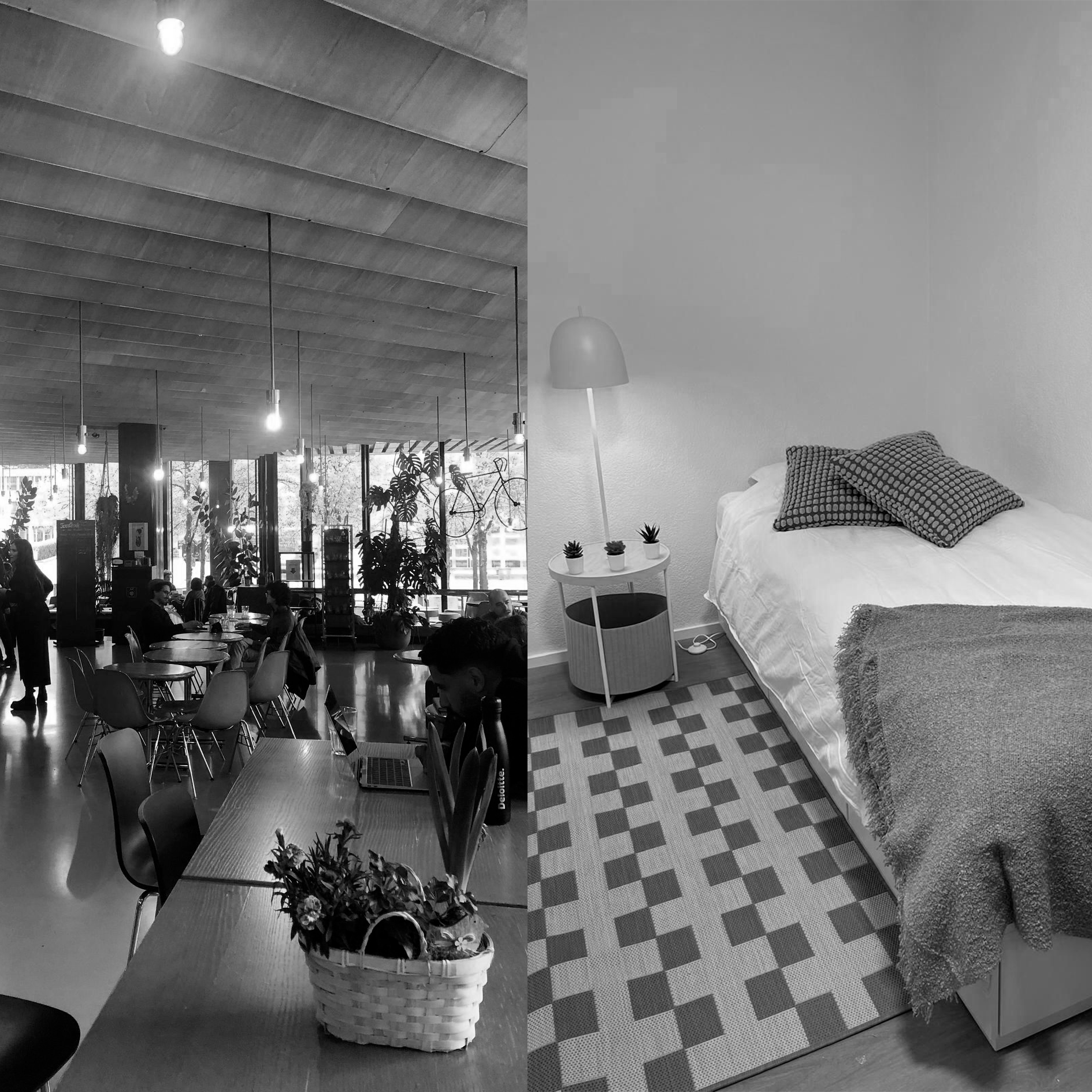
The Alumni is a bar/lounge area in the centre of campus. It has constant ambient sound with music, people, pool balls clacking, and coffee being made. For that reason, the roof is made of noise treatment panels. Nevertheless, the volume is rather loud, with a live ambience comprising various sounds.
Specific acoustic events:
- music
- chatting
- people moving
- coffee machine (both the whistling milk heating and the buzzing coffee extracting)
- pool table and ball clacking
- chairs and tables moving
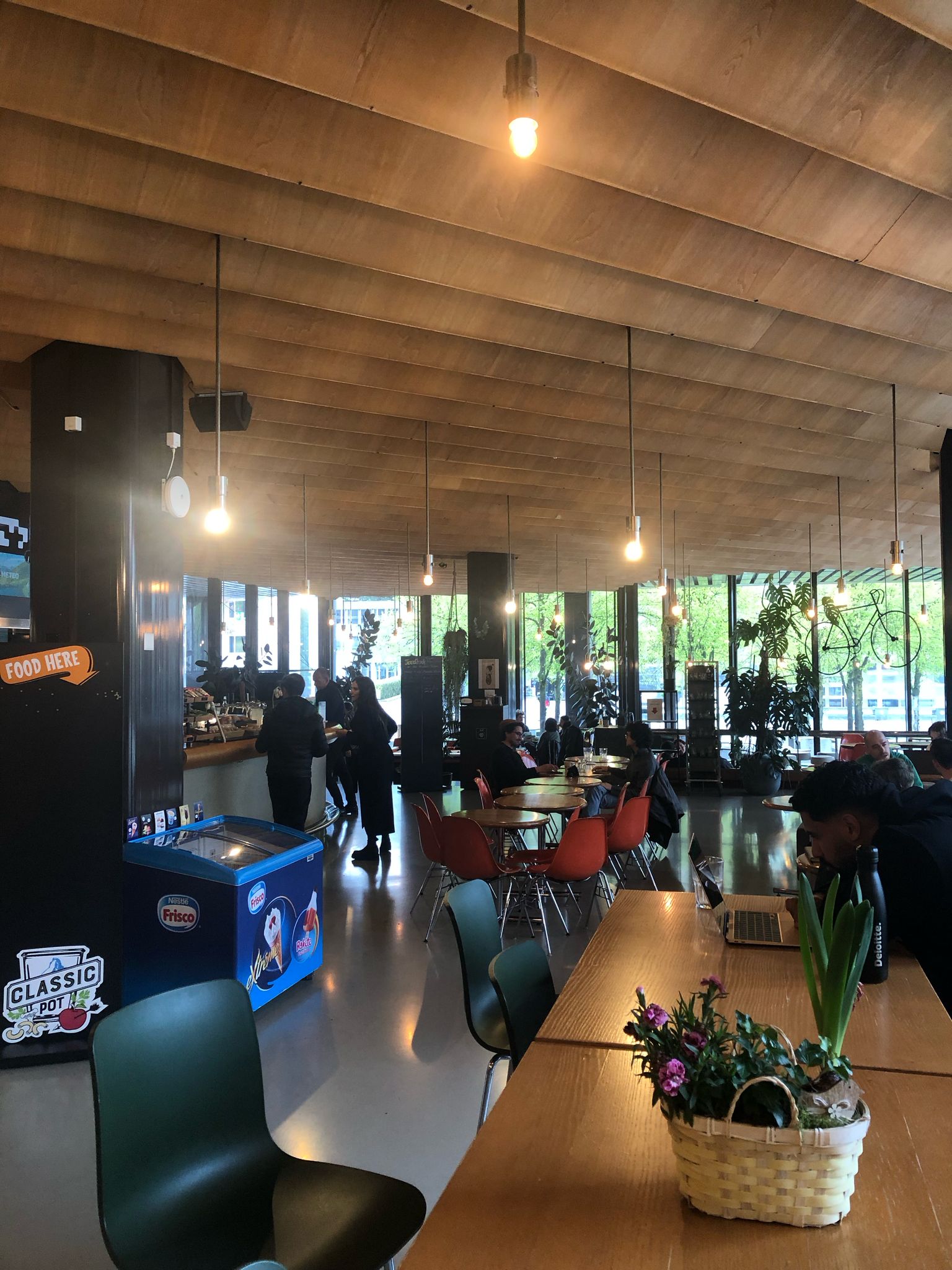
The bar consists of a front space, with windows all around and a somewhat organic shape. It also has a central rectangular-shaped space, comprising on one side of the bar and windows on the other. Finally, it has a backspace in a circular shape. These three spaces are separated by a set of 3-4 steps.
The acoustic signature of the space can be described as live and boomy. The sounds are mixed, giving a muddy feeling to the voices just a few meters away from you. The loudness of the room and the unbalanced sounds give it, however, a sort of chaotic harmony that one might enjoy while drinking a beer.
2. My appartment, Zürich
My apartment is on a street perpendicular to Langstrasse in Zürich. Due to its location, it has constant ambient sound coming from the outside. In this 14m2 space, having the window open or closed has a massive impact on the acoustics, with 90% of the outside noises being either removed or considerably reduced when the window is closed. The recording has the window slightly open.
Specific acoustic events:
- Chatting
- Cars
- Buses
- Birds
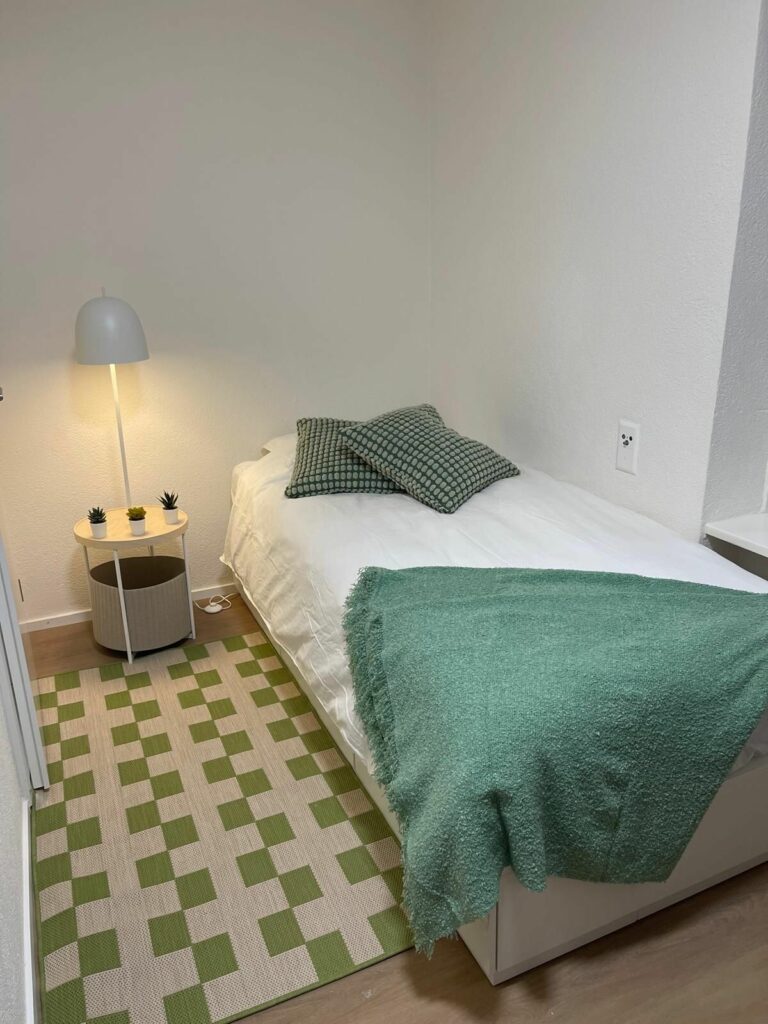
The acoustic signature of the space can be described as calm and quiet when the window is closed, with very muddy and quiet sound signatures coming from the outside. However, when the window is open, my bedroom’s acoustic signature can be considered live, loud and boomy. The loudness of the sounds gives it a distinct urban ambience, like one might expect in a city centre.
Assignment 2 – Exploring the Emotional Impact of Everyday Sounds
During this exercise, I studied two daily situations and my own perception of them. The intention was to understand how everyday sounds can evoke emotions and influence perception.
Bus #32, Zürich
This audio comes from the bus number 32 at 5 pm on a sunny Friday afternoon. The scene is very lively with numerous people cramming into the bus at the Limmatplatz Station. A diverse population is on the bus, from children to elderly people, with skaters and businessmen in between. The traffic is heavy, and the general acoustic scene at the station is lively.
List of sounds from most emergent and catchy to most overheard:
- People Chatting (constant)
- Engine Noise (loud at first and at the end)
- Traffic sounds (constant)
- People moving in the bus (constant)
- Bus driver announcment (momentary at the end)
- Laughter (faint)
- Bus Door bipping (very faint at the end)
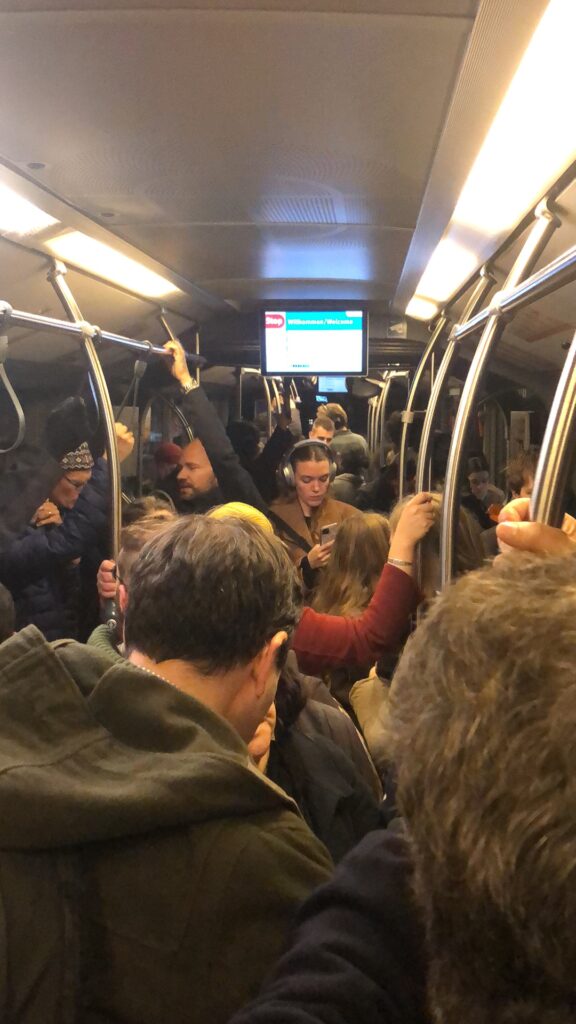
The sound scene is a constant overlapping of loud sounds. Truthfully, I am immune to it by habit. Still, by consciously opening myself to the experience, I see a very overwhelming scene with people and things moving and making sounds everywhere around me, augmented by the feeling of being crammed. I see how this situation could be very tiring acoustically over a long period of time.
However, as I am used to it, it is also a short moment signifying going home. It therefore has a sort of comfort that is triggered by the experience, including the acoustic.
Joseph-von-Deschwanden-Platz, ETH Hönggeberg
This audio comes from the Joseph-von-Deschwanden-Platz in the centre of ETH Honggeberg. It’s lunch and people are out to get food at the food trucks and the different mensas and all have to come through here. Since it rained 30 minutes prior, the crowd is smaller than usual at the food trucks.
List of sounds from most emergent and catchy to most overheard:
- People walking (punctual)
- Kebab electric cutter (Buzzing sound in the background)
- Bus (at the beginning)
- People chatting
- Laughter (faint)

The sound scene has a lot of sounds but a general calmness due to the poor weather. It is relaxing in contrast to the busy architecture studio and provides a balancing break. The Kebab cutter is relatively annoying after hearing it for a while due to the repetition of a distinct, unpleasant, electric cutting sound.
Assignment 3 – Empirical and numerical estimation of room acoustic properties
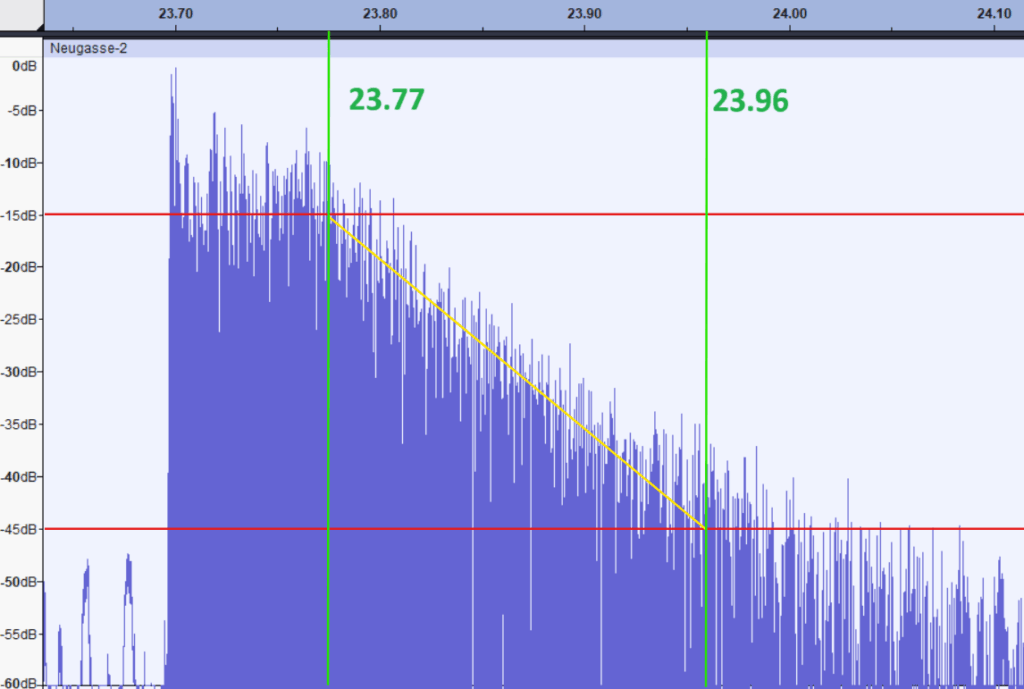
1. Appartment, Zürich
Features:
- Small one-bedroom apartment
- City Centre
- Rainy day
Measured Reverb time (30 dB): 0.19s
Calculated Reverb time (T60): 0.38s
500Hz Reverb time: 1.38s
1000Hz Reverb Time: 1.81s
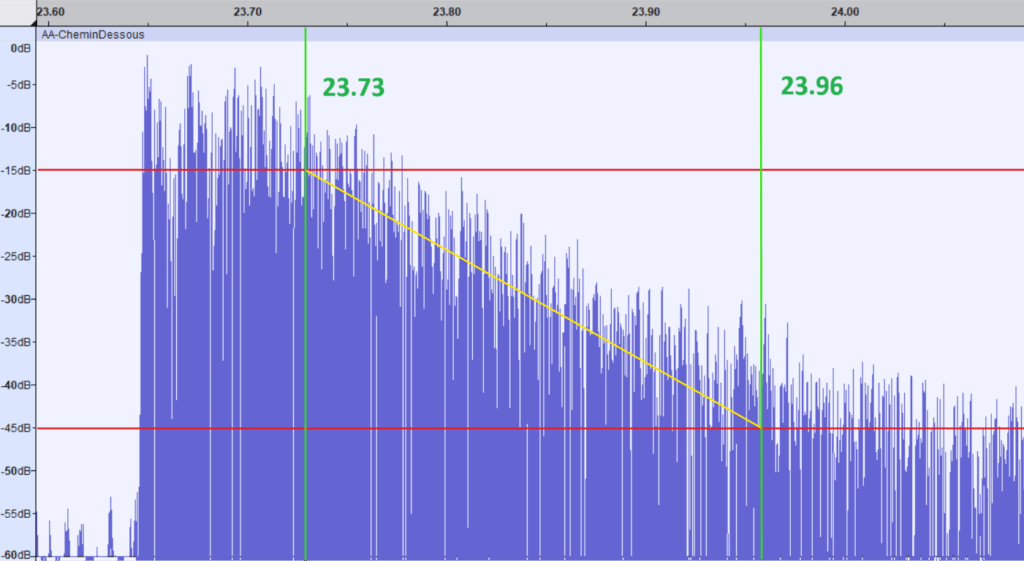
2. Bedroom, Tannay
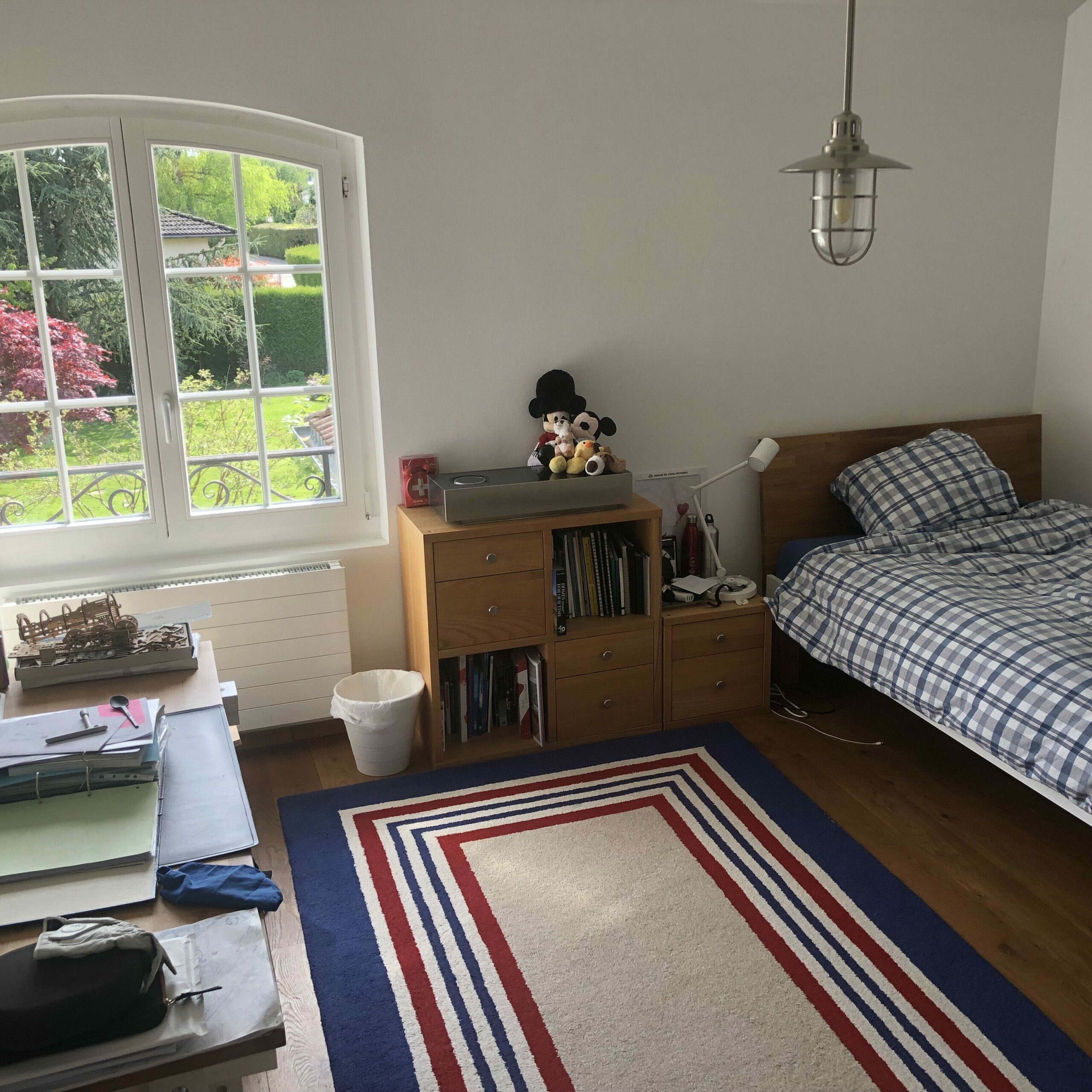
Features:
- Large bedroom
- Countryside
- Sunny day
Measured Reverb time (30 dB): 0.23s
Calculated Reverb time (T60): 0.46s
500Hz Reverb time: 1.55s
1000Hz Reverb Time: 2.03s
Assignment 4 – Assembling all puzzle pieces
Studio, Zürich
1. Introduction
Function: multiple (sleeping, working, cooking, living in general)
Situation: Studio, 13m2, one large window, agitated street in the city centre and therefore a lot of exterior noise.
Reverberation Time: 0.38s
2. Legal standards
Architectural standards: SIA 118
Accoustical standards: SIA 181 – Sound Insulation in Buildings
Key legally regulated acoustical features (SIA 181):
- Minimum sound insulation requirements (window, door): R’w + C ≥ 37 dB
- Necessary adequate impact sound insulation (large housing building with multiple apartments): L’n,w ≤ 48 dB.
- Facade construction adequate to the external noise: D₂m,nT,w ≥ 30–40 dB.
3. Acoustic Absorption
Furniture is positioned to save space and utilise as much of it as possible. No acoustic intention was involved in the space allocation, but still some key elements stand:
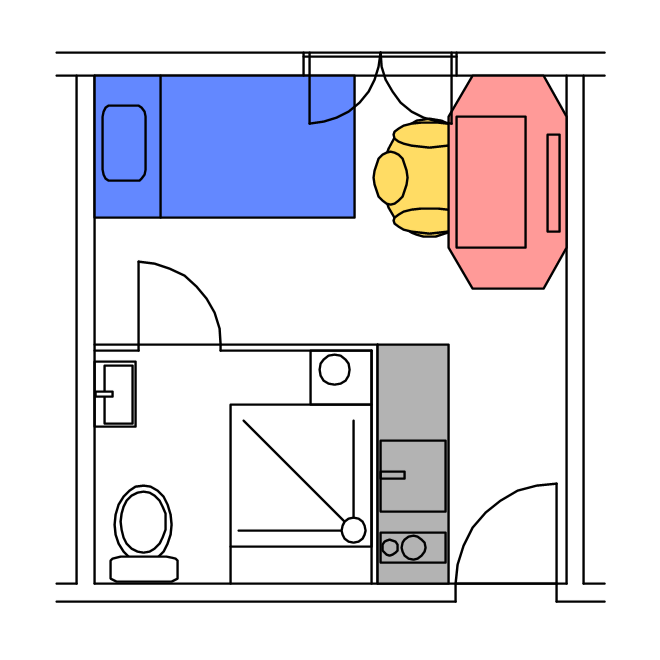
Acoustic Effective Elements:
- Bed (blue): 2.2 m2, Fabric, mid-low-high frequency absorber
- Desk (red): 1.2 m2, Wood, mid-high frequency absorber
- Kitchen counter (grey): 1.2 m2, wood, mid-low-high frequency absorber
- Chair (yellow): 0.7 m2, Fabric, mid-high frequency absorber
- (Window : 2 m2, glass and PVC, mid-low-high frequency absorber)
Furnishings that favour the diffuse reflection of sound:
- Bed
- Desk
- Chair
- Bedside table
- Desk and kitchen objects
- Decorations
Particularly reflective materials:
- Glass (windows, shower door)
- Table top
- Kitchen top
4. Analysis
The apartment is generally relatively well insulated for such a densely populated building. The SIA’s regulations are up to date due to the recent renovation of the apartments with thick walls and doors and new floors with a cement screed.
One unfixable mistake is that the lighting requirements of the space governed the window positioning process and had consequences for the acoustics. In this case, there is no quiet zone in the apartment, but in the bathroom. However, an exterior shading system protects you from the noise.
Further improvements could include renovations of the common spaces that acoustically pollute the apartments (loud corridor floor tiles). Another possibility would be to renovate the windows to include triple glazing or a strong frame (sound infiltration).
Final assignment
1. Analysis
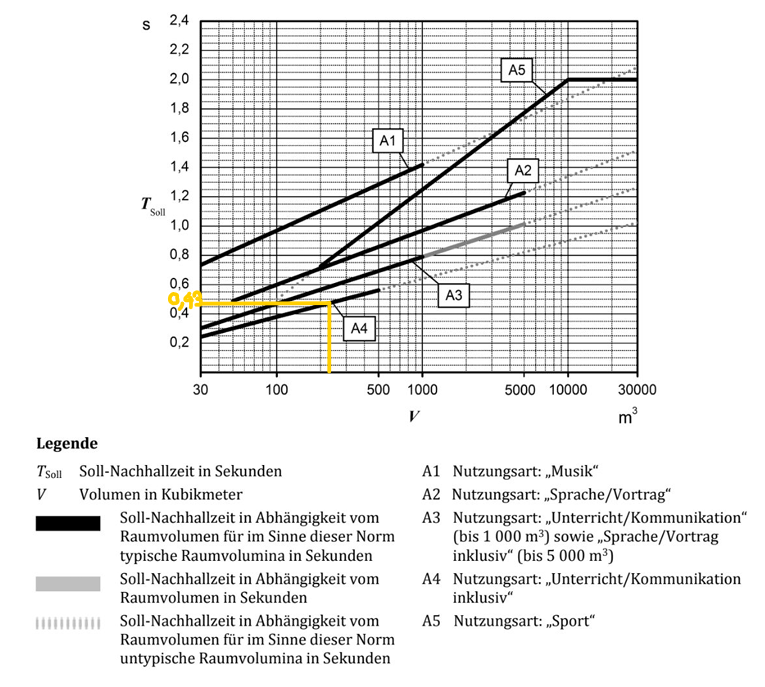
Room type: A4- Inclusive Classroom
Volume: 243 m3
Reverberation Time Target: 0.43s
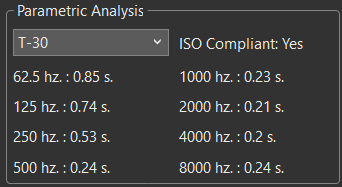
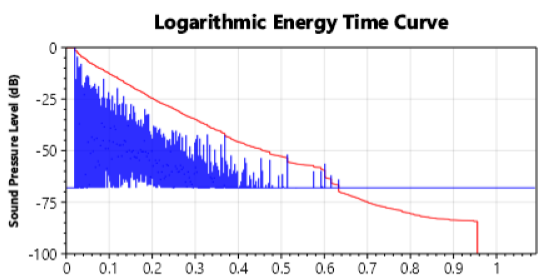
Actual Reverberation time: 1.4s-2.8s
Average Reverberation time: ~2s
The room fails to meet the target set by the SIA standard. It is worth mentioning that the room contains plenty of objects that scatter sound, which would reduce the RT60 value.
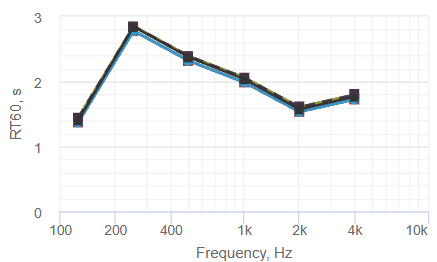
The main reason the Reverberation time fails to meet the target is the room’s construction. Indeed, it is what we could call a ”concrete aquarium” where all surfaces are concrete except for 6 wooden boards on one of the long walls and some lightweight shelves at the back and on the other long side.
2. Target and Modifications
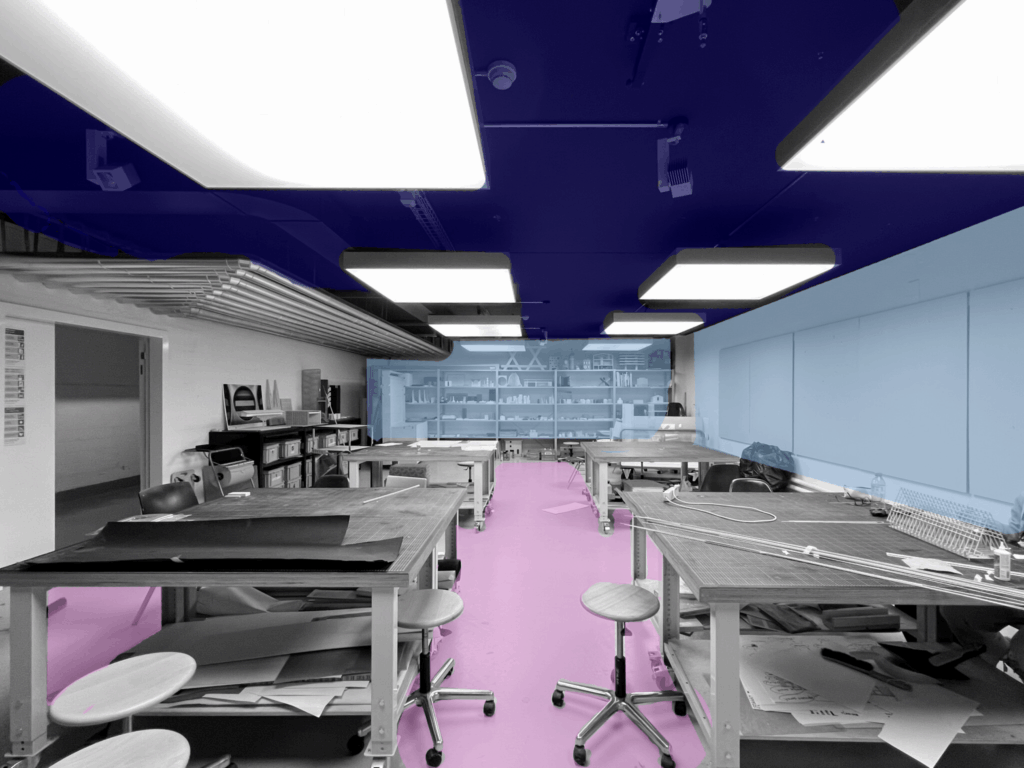
Target: Bring the Reverberation time down and while conserving/improving the quality by adding acoustic treatment to the room. The main focus is the lower-mid frequencies.
Modifications
- Ceiling: Absorbent mousse 3cm (Soniflex) (hidden by the lights).
- Floor: Linoleum Covering.
- Back and Side Wall: Acoustic Curtains (Also produces a better curated presentation room and flat background for model pictures).
- Chairs: Change the covering to a fabric (more comfortable for long modelling hours or presentations).
3. Results